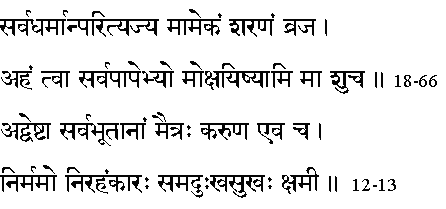
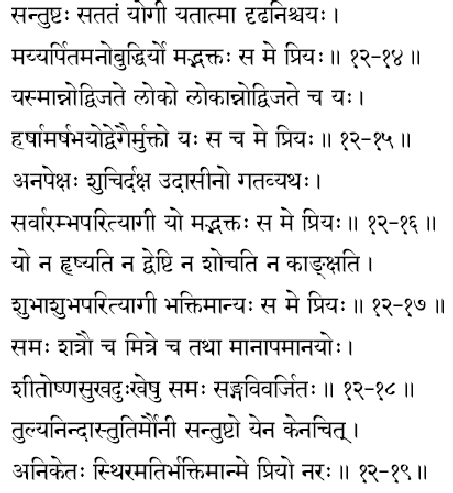
Nagayya sings slokas from Bhagavad Gita: ch.18-66; Ch.12: 12-15, 17-19; Ch.6-30, followed by a Bhajan: sarvamangalanAmA SitaRama Rama (Film: Bhakta Potana - 1942)
The composer who placed the sarvadharmaan slokam from the last chapter of the Gita first (Gita:18-66), the chapter-12 slokams next, and yo maam pashyati sarvatra (6-30) last in the Bhakta Potana film has attempted to convey the deep import of the sarvadharmaan slokam through this sequence.
The slokam sarvadharmaan parityajya does not state, as commonly understood, that past sinful acts are pardoned when the individual subsequently surrenders totally to the Lord. The individual has to suffer/enjoy the consequences of the past actions according to the Law of Karma. As a result of such experience, if the individual learns, enters into a spiritual discipline and develops the traits mentioned in the slokas 12-20 of ch.12, he/she will be able to surrender the ego to God's Will - in the manner envisaged by Ramana Maharishi who spoke of the ego dropping after genuine and intense self-enquiry and the true Self shining forth in all glory. Such a person will see God "everywhere and in every thing", as stated in the Gita slokam 6-30: yo maam pashyati sarvatra.
Thereafter, all his actions will be in accordance with true Dharma as perceived through Universal Consciousness and hence even if there is an apparent conflict with the ordinary laws of society, no sin will accrue as a result of such self-less actions. The composer who strung together these slokas from the Gita in a particular sequence and have it chanted/sung soulfully with great devotion by Nagayya has succeeded in conveying to us the essence of this core-message of the Gita.
The sarvadharmaan slokam does not also advise us to give up our normal duties. There might be occasions in our life when we may have to engage in actions which appear to be contrary to the dharmic rules prescribed by religion, society, etc. Arjuna, for example, faced this issue and almost walked out of the field of battle, contrary to the kshatriya dharma. Krishna spoke to him about a higher duty which would be clear when one develops a samabuddhi as described in slokas 12-20 (Ch.12) and acts according to the dictates of the Universal Conscienceness. Then, Krishna assures, the apparent transgressions (sins) according to the normal laws of society will not taint such an evolved individual whose individual consciousnes has merged into the universal consciousnes. Adi Sankara in Bhaja Govindam explained this transformation leading to a blissful state of existence, thus: yoga rato vaa bhoga rato vaa / samgarato vaa samga vihiinah / yasyad brahmaNi ramate chittam / nandai nandati nandatyeva. योग रतो वा भोग रतो वा संगरतो वा संग विहीनः | यास्यत् ब्रह्मणि रमते चित्तं नंदति नंदति नंदत्येव ||
Periodically, individuals with such a highly evolved universal perception do appear and lead others to act. They are truly the avataars endowed with Godly powers and universal consciousness, who have no selfish interest whatsoever in the results of their actions.
|
|
18.66.
Abandoning all attributes, come to Me as your sole refuge; 12.13
He who hates no creature, who is friendly and compassionate to all, 12.14
Ever content, steady in meditation, self-controlled, possessed of firm
conviction, 12.15
He by whom the world is not agitated and who cannot be agitated by the world, 12.17
He who neither rejoices, nor hates, nor grieves, nor desires, renouncing good
and evil, 12.18
He who is the same to foe and friend, and also in honour and dishonour, 12.19
He to whom censure and praise are equal, who is silent (restrained in speech), content with anything
(for the maintenance of the body), 6.30
He who sees Me everywhere and sees everything in Me, |
|
|
Lyrics of Bhajan from "Bhakta Potana" - (Incomplete). You can view the video clip of this Bhajan (1942) on You Tube at: http://www.youtube.com/watch?v=1Uag6QDev2A sarva mangala
naamaa sita-rama rama Meaning: The 'Rama'
Mantram is sacred and giver of auspiciousness. I
shall be grateful to receive the correct and complete lyrics, meaning, |
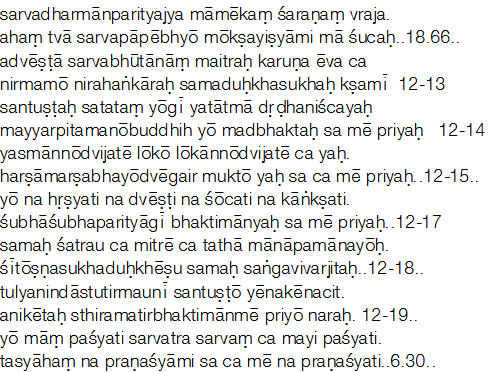
Slokam 66, Chapter XVIII:66. Abandon all duties and come to Me the only refuge. I will release thee from all sins; grieve not! slokams 13-20, Chapter XII13. Who has ill-will towards none, who is friendly and compassionate, who has shed all thought of 僧ine' or 選', who regards pain and pleasure alike, who is long-suffering; 14. Who is ever content, gifted with yoga, self-restrained, of firm conviction, who has dedicated his mind and reason to Me葉hat devotee (bhakta) of Mine is dear to Me. 15. Who gives no trouble to the world, to whom the world causes no trouble, who is free from exultation, resentment, fear and vexation,葉hat man is dear to Me. 16. Who expects naught, who is pure, resourceful, unconcerned, untroubled, who indulges in no undertakings,葉hat devotee of Mine is dear to Me. 17. Who rejoices not, neither frets nor grieves, who covets not, who abandons both good and ill葉hat devotee of Mine is dear to Me. 18. Who is same to foe and friend, who regards alike respect and disrespect, cold and heat, pleasure and pain, who is free from attachment; 19. Who weighs in equal scale blame and praise, who is silent, content with whatever his lot, who owns no home, who is of steady mind,葉hat devotee of Mine is dear to Me. 20. They who follow this essence of dharma, as I have told it, with faith, keeping Me as their goal,葉hose devotees are exceedingly dear to Me. Slokam 30, Chapter VI30. He who sees Me everywhere and everything in Me, never vanishes from Me nor I from him. |