Audio

SrI vishNu sahasra nAmam - Phalashruti Slokas -
|
|
Phala Shruti
|


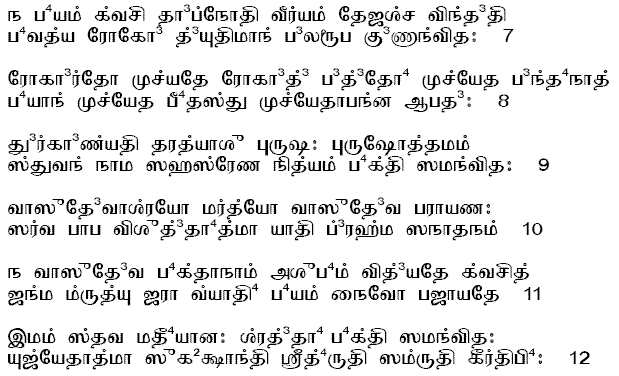
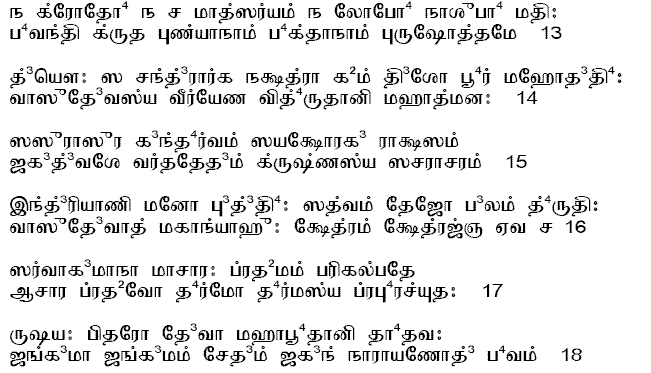

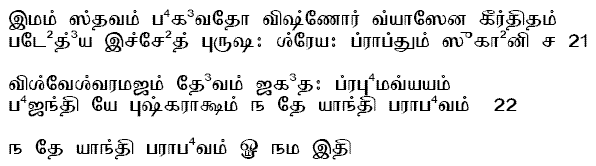
|
SrI vishNu sahasra nAmam – phala Sruti - 1. iti idam kIrtanIyasya keSavasya mahAtmanah | The above is addressed by bhIshma to yudhisThira at the end of the 107 Sloka-s
containing the 1000 nAma-s of bhagavAn. The meaning is: "Thus, the thousand
divine names of bhagavAn keSava, the Supreme Being, Who is worthy of being
praised, have been sung in their entirety". SrI BhaTTar comments that the
word `kIrtanIyasya' has been chosen to indicate that bhagavAn richly deserves
the praise, and that by using this word, bhIshma is telling yudhishThira that he
should begin the recitation of the names right away. The reason for the same is
given by the choice of the name keSava (the Creator of brahmA and Siva – see
the interpretation for the nAma keSava – nAma-s 23 and 654), and mahAtmanah
(He is the Supreme Being). The word `divyAnAm' (divine) applied to the nAma-s
signifies that the nAma-s are worthy of being sung in this world as well as in
SrI vaikunTham. The word `aSesheNa' is used to denote that nothing that is
significant or important has been left out by bhIshma in his communication to
yudhisThira, and everything that needs to be known has been taught. SrI Sa'nkara explains the word `aSesheNa' to mean `a-nyUna, an- atirikta' –
neither less, nor more, but exactly thousand nAma-s. The implication is that the
choice of the thousand names by bhIshma are significant, and are not randomly
chosen. SrI Sa'nkara also refers us back to one of the initial six questions –
kim japan mucyate jantuh (see Introduction for detailed meanings), and points
out that these 1000 divine nAma-s are the ones that are the object of `japa'
referred to therein. He points out that `japa' consists of three kinds - ucca,
upAmSu, and mAnasa – loud, whisper, or in the mind (trividha japo lakshyate
– uccaA, upAmSu, mAnasa lakshaNah trividho japah). The words prakIrtitam in
the current Sloka answers that all three means – chanting loudly, through a
low tone, or by contemplating in the mind, can be used in singing His praise (kIrtana). This Slokam emphasizes that these nAma-s are divine, and are sung in SrI
vaikunTham by the nitya sUri-s themselves. They are specifically selected as
sung by the Rshi-s (Rshibhih parigItAni – see the Introductory section). This
stotram is unlike any other stotram that we know of. It was first revealed in
Lord kRshNa's presence. ya idam SRNuyAt nityam yaScApi parikIrtayet | In this Sloka, the qualifications for reciting the stotra, and the result
from recitation are declared in general terms. "Nothing inauspicious or
unwelcome will accrue to that man in this world or in the world beyond, when one
hears this daily or recites it". SrI BhaTTar comments that he, who according to his qualification and ability,
hears it or meditates on it in his mind, will encounter nothing inauspicious in
this world, or hereafter. Note that the benefit is attained by chanting, as well
as by listening. By the term `hereafter (amutre ca)', lesser worlds than SrI vaikunTham, such
as svargam, brahma lokam etc. are meant. SrI Sa'nkara points the case of yayAti
and his father nahusha, both of whom ended up suffering after reaching brahma
lokam and indra lokam respectively, because they committed sins against brAhmaNa-s
after reaching these higher worlds. Such inauspicious instances won't happen to
those who chant or hear this divine stotram – yayAti nahushAdivat aSubha
prApti abhAvam. vedAnta-go brAhmaNah syAt kshatriyo vijayI bhavet | The next few Sloka-s declare the benefits attained by chanting the hymn,
hearing it chanted etc. SrI BhaTTar has categorized the benefits as follows: - The current Slokam declares the benefits attained by people of the four
varNa-s, when they chant the stotram without necessarily directing their
chanting for any specific benefit, and do so without necessarily following any
special discipline etc. - The next Slokam (Slokam 4 in this sequence) declares
the benefits attained by those who chant the stotram with specific benefits in
mind. - Sloka-s 5 to 8 declare the benefits attained by those who chant the
hymns following discipline such as getting up early in the morning, taking a
bath etc., before chanting. The organization along the above lines will be clearer as we see the meanings
of the Sloka-s, in particular, Slokam 5 etc. Thus, there is benefit that is bestowed by the recitation of the hymn,
whether it is done by those with intense devotion or is chanted without
necessarily following any specific discipline, whether specific benefits are
sought by the person chanting the hymn or not, etc. (Note: Based on Slokam 2 of
this sequence, whatever benefit is described for chanting the hymn, equally
applies for listening to the hymn being chanted). The current Sloka declares that by reciting this hymn or hearing it being
chanted, (without necessarily following any specific rules etc., and without
specifically seeking any benefit), still certain benefits are attained by people
belonging to the four varNa-s. Thus, a brAhmaNa reaches the knowledge of the
vedAnta-s, in other words, the knowledge of the self and its relation to the
Supreme Self. If he is a kshatriya, he will be victorious in war. A vaiSya (businennman)
will attain immense wealth, and a SUdra will be bestowed with great happiness. SrI Sa'nkara gives an elaborate explanation for the words `vedAnta-go
brAhmaNah syAt', and using the meaning "The brAhmaNa will get KNOWLEDGE of
the vedAnta-s, he proceeds to argue that sage vyAsa is declaring through this
Slokam that simply reciting the hymn is not the means to salvation (japa karmaNA
sAkshAt mukti Sa'nkAyAm, karmaNAm sAkshAt mukti hetutvam nAsti, api tu
j~nAnenaiva moksha iti darSayitum `vedAntago brAhmaNah syAt' ityuktam) , but the
knowledge obtained by the recitation is the path to salvation. We won't go into
elaborate details of SrI Sa'nkara's argument on this point in the vyAkyAnam for
this Slokam; however, this is one instance of how the vyAkhyAna-kartA-s orient
their vyAkhyAna-s so that they can establish their philosophy, and argue that
important works such as this one by veda vyAsa can be `shown' to support their
system of philosophy. SrI v.v. rAmAnujan explains that the knowledge that is
attained by chanting the hymn is the realization of the eternal relationship
between the soul and the Supreme Soul as servant and Master (not the realization
that everything is imaginary and non- existent, except Brahman, as SrI Sa'nkara
defines true knowledge). One commentator adds that this Slokam – by referring to the benefits
attained by all the four varNa-s, implies that there is no constraint in anyone
chanting the hymns. Some AcArya-s have asked the women among their followers to
refrain from chanting the hymn either in part or in full. The instructions vary
from being allowed to chant only the 107 Sloka-s starting from "viSvam
vishNuh" up to "Sa'nkhabRn- nandakI", not chanting anything,
chanting the stotra in its entirety, etc. To my knowledge, there is no
restriction listening to the hymn, which is as powerful in conferring benefits
as chanting the hymn. In all cases, one's own AcAryan's instructions should be
rigorously followed. dharmArthI prApnuyAt dharmam arthArthI cArthamApnuyAt | In this Slokam, it is declared that those who desire righteousness (dharma),
will be blessed with that; those who desire wealth will be blessed with wealth;
those who are after the pleasures of life, will be bestowed with all pleasures
of life; those who desire progeny will be blessed with children. -dAsan kRshNamAcAryan |