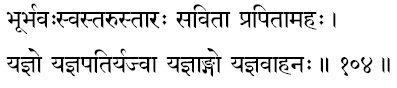
bhUr-bhuvas-svastarus_tAraH savitA pra-pitAmahaH |
yaj~no yaj~na-patir_yajvA yaj~nA'ngo yaj~na-vAhanaH ||
om bhUr-bhuva-svas-tarave namaH.
om tArAya namaH.
om savitre namaH.
om prapitA-mahAya namaH.
om yaj~nAya namaH.
om yaj~na-pataye namaH.
om yajvane namaH.
om yaj~nA'ngAya namaH.
om yaj~na-vAhanAya namaH.
967. bhUr-bhuvas-svas-taruH –
He Who is the tree for the beings of the three worlds -earth, sky and heaven (svarga loka)..
om bhUr-bhuvas-svas-tarave namaH.
The term bhU here refers to this world; bhuvaH refers to the middle world,the antariksha or sky, and sva refers to the heavenly world (svargaloka). The term `taru' means `tree'. Since He is the protectionfor all the beings of all the three worlds, and since He bestowsall the fruits to the beings of all these worlds, He is called the tree for the beings of the three worlds. SrI BhaTTar explains the nAmaas "bhUr-bhuvas-svar-upalakshitaiH pakshi pathikairiva prANibhiH upajIvyamAnac-chAya patralapArijAtaH bhUr- bhuvas-svas-taruH"- He is like the pArijAta, the celestial tree, for all the beings living in the worlds beginning withearth, sky and heaven, evenas a tree is a welcome resort for the birds and the travelersby virtue of its green foliage and cool shade.
SrI Apte gives the following meanings for the terms bhU-loka, bhuvar-loka andssar-loka:
- bhU-loka - the world in which we live, as opposed to antariksha or svarga.
- bhuvar-loka - the second of the three vyAhRti-s; the space immediately abovethe earth.
- svar-loka: paradise, the paradise of indra, and the temporary abode ofthe virtuous after death, the space above the sun or between the sun and thepolar star, the third of the three vyAhRti-s.
SrI VeLukkuDi kRshNan notes that in this nAma only three out of the fourteenworlds, namely the bhU, bhUva and svar-loka-s, are mentioned,and the protection aspect described in this nAma refers to the naimittika pralaya, when the three worlds referredto by the terms bhU. Bhuva,and svar-loka-s get submerged in the waters during thepralaya, and bhagavAn protects all the beings of these three worldsby swallowing them and keeping them in His stomach. However, Heis also the Protector for all the beings in all the fourteen worlds. So the nAma can be understood to mean that bhagavAn is the Protectivetree for all the beings of all the fourteen worlds.
SrI BhaTTar gives the following support:
samASritAt brahma taroH anantAt |
nis-samSayaH pakva phala prapAtaH || (VP 1.17.91)
"If a person resorts to the eternal Tree of Brahman, there is no doubt thatthe ripe fruit (of release from the bondage of samsAra and the attainment ofmoksha) will certainly fall in his hands."
SrI v.v. rAmAnujan refers to nammAzhvAr's tiruvAimozhi pASuram 2.8.5, whereAzhvAr refers to the same concept:
OvAt tuyarp piRavi uTpaDa maRRu ivvevvaiyum
mUvAt tani mudalAi mU ulagum kAvalOn.. (tiruvAi. 2.8.5)
"Single-handedly, bhagavAn protects all the beings of the three worlds,who are full of sufferings etc. He is the Sole cause for all the beings, and after creating them, He takesresponsibility for protectingthem, and does not back down under any circumstance".
Specifically to be noted in this nAma is the emphasis on the protectionaspect of bhagavAn (taru - one that provides the cool shadeand protection from the torture of the heat of samsAra). In histiruvAimozhi, nammAzhvAr emphasizes that even though bhagavAn is responsiblefor all three functions - creation, protection and destruction, protection is His primary concern (kAkkumiyalvinan kaNNa perumAn -tiruvAi. 2.2.9). This protection aspect of bhagavAn isto be specially enjoyed in this nAma.
SrI veLukkuDi kRshnan gives a quote from SrImad rAmAyaNa where rAma is describedby tArA as a tree of protection, hope and refuge for all:
nivAsa vRkshaH sAdhUnAm ApannAnAm parA gatiH |
ArtAnAm samSrayaScaiva yaSaSca eka bhAjanam | | (kishkindA. 15.19)
"(rAma) is the protective tree for the sAdhu-s or the virtuous people; He is the safe Abode for the suffering; He is the Protector for those whohave no other protection; He is the One who is worthy
of praise".
SrI Sa'nkara uses the root `tR - plavana taraNayoH - to cross over, toswim', in his primary interpretation for the nAma, and gives the meaning"One Who helps in crossing over the three worlds - bhU loka, bhuvarloka and svar loka". His vyAkhyAnam is: "bhUr-bhuvaHsvaH samAkhyAni trINi vyAhRti rUpANi SukrANi trayI sArANibahvRcA AhuH | tair-homAdinAjagat-trayam tarati plavate vA iti bhUr-bhuvas-svas- taruH". He bases his interpretation onthe following Rg vedic mantra,which also occurs in the taittirIya Upanishad:
bhUr-bhuva-suvariti etAs-tisro vyAhRtayaH | ..
bhUriti vA ayam lokaH | bhuvarityantariksham | suvarityasaulokaH | ...
bhUriti vA agniH |bhuva iti vAyuH | suvarityAdityaH | .. bhUriti vA RcaH |
bhuva iti sAmAni | suvariti yajUgmshi | .. bhUriti vai prANaH |
bhuva ityapAnaH | suvariti vyAnaH |"
"BhagavAn created the three worlds; then He created agni in this world,vAyu in the sky, and sUrya in the heaven. From these came the threeveda-s: Rg veda from agni, yajur veda from vAyu, and sAma veda fromthe Sun. Out of these again came the three vyAhRti-s or sounds: bhUH from agni, bhuvaH from vAyu, and svaH from the Sun. By performinghoma using these three vyAhRti-s, one crosses the three worlds". Based on this, Sri Sa'nkara's interpretation for the nAma as`One Who helps those who perform homa using these vyAhRti-s to crossover the three worlds that are the origin of these three vyAhRti-s".
An alternate interpretation given by SrI Sa'nkara is - bhUr-bhuvaH svarAkhyamloka trayam vRkshavat vyApya tishThati iti bhUr-bhuvaH- sars-taruH - Lord vishNu has this nAma signifying that He isspread out in the threeworlds bhUH, bhuvaH and svaH like a tree.
SrI vAsishTha explains the nAma as:
”bhUH iti bhU lokaH, buvaH iti antariksham,svaH iti dyu-lokaH, ete trayo lokAH trayaH skandhA iva yamASritya tishThanti, sa eteshAm AdhAro mUla-bhUtaH parameSvaraH tarur-ivasthito bhUr-bhuvas-svas-taruH - "
He Who serves as the tree underwhich all the beings of this world, the sky and the heaven seek refuge,is bhUr-bhuvas-svas-taru".
968.tAraH–
Savior; He Who is a ferry to cross theocean of samsAra.
om tArAya
namaH.
We saw this nAma in Slokam 37 earlier (nAma340).
The root from which the nAma is derived is
tRR – plavanasantaraNayoH – to cross over, to swim.
He who helps the jIva-s that are deeply immersed in the ocean of samsAra,to cross this ocean.
For nAma 340, SrI BhaTTar gives theinterpretation "Savior" –
sarva samsAra bhayAt tArayati iti tAraH -
One Who protects us from the ocean of samsAra.
He gives a quote from the atharva Siras in support:
garbha janma jarA maraNa samsAra sAgaramahA bhayAt tArayatiiti |
tasmAt tAraH |
"He makes all cross over the greatfears of the ocean of samsAracomprising conception, birth, old age, and death. Therefore, He iscalledtAraH".
Note that bhagavAn Himself is beyond allthese fears, since He isnever born (a-jAyamAnaH), He is beyond aging (a-jaraH), and beyonddeath
(a-maraH).
SrI v.v. rAmAnujan gives reference totiruma'ngai AzhvAr's periyatirumozhi, where the guNa of bhagavAn signified by the nAma tAraH ispraised:
nandA naragattu azhundA vagai nALumentAi!
tonDar Anavarkku in aruL SeivAi ………… (periya tiru. 11.8.10)
"You Who help Your devotees by makingsure they do not get submergedin the hell-like experience of samsAra".
Because samsAra is compared to an ocean,and bhagavAn helps crossthis, He is traditionally compared to a ferry. SrI kRshNan refers usto ANDAL'sreference to Him as the ferry to cross all miseries: nALumtunbak kaDal pukku vaikuntan enRu Or tONi peRAdu uzhalginREn (nAcci.tiru. 5.4). SrI kRshNan also refers us to the divya dESam by nametiru nAvAi (literally meaning "The Blessed Ship"), where Lordmukundangives moksham to the devotees who worship Him.
Drawing from an example from SrI KRshNan,all that a measly worm hasto do to cross from one peak to another peak in its lifetime, is toclimb on alion that jumps from the first peak to the second peak, andin the process, the worm has achieved the otherwise impossible feat.Similarly, all that the jIva has to do is to surrender to Lord nRsimha,the man-lion incarnation, and He will make sure that the jIvacrosses the insurmountable obstacle of crossing the ocean of samsAra.He is like a boat that carries one from one shore to the othershore. All that the individual has to do is to get into the boat,and leave the navigation to the boatman.
SrI Sa'nkara's interpretation is also thatbhagavAn has this nAmasignifying that He helps us cross the ocean of samsAra – samsArasAgaramtArayan tAraH. His alternate interpretation is "tAraH praNavovA" – The word tAra refers to the praNava mantra, since meditatingon the praNava mantra uplifts one from the ocean of samsAra.SrImad SrImushNam ANDavan also points to the significance ofthe praNava mantra as the uplifter from samsAra.
SrI cinmayAnanda explains the nAma as"One Who helps us cross over;the Eternal Boat-man, to whom, if the devotee can surrender inunswervingfaith and true devotion, He will surely row them across theOcean of samsAra. That One is tAraH. Through exclusive, devoted meditation,alert with understanding, the individuality in each of us wakesup to the higher plane, and there, in that Be-attitude to experiencethe Self – the Eternal Brahman – SrI Hari".
The dharma cakram writer notes that weshould take a hold of bhagavAninstead of being taken hold of by nature. We should dedicateourselvesto His service in everything we do. The rAma nAma is called`tAraka mantra', because it protects those who meditate on thistAraka nAma. Just as hanumAn was able to cross the ocean by chantingLord rAma's name, we will be able to cross the ocean of samsAraby meditating on His name. He quotes the common saying in tamizh:
"rAman irukkum iDattil kAman illai; kAman irukkum iDatitil rAmanillai"
– (Where there is rAma, there is no desire in material things;where is desire in material things, there is no dedication torAma". The more intensely we resort to the tAraka mantra, the fasterwe will be relieved from the bondage of
samsAra.
969.savitA– He Who produces.
om savitre
namaH.
SrI vAsishTha indicates the root for thenAma as sU – prANi garbhavimocane – to produce, to bring forth. sUte sarvam jagat iti savitA;sarvasyautpAdaka ityarthaH – He Who creates everything in the universeis savitA.
We studied this nAma in Slokam 94 (nAma887), with the same genericmeaning, but interpreted by SrI BhaTTar as a reference to bhagavAn inthe formof the Sun (the producer of rain, crops etc)., since the contextthere was the description of the arcirAdi mArga, of which Sun isthe seventh step. The current interpretation refers to bhagavAn asthe Creator of everything – sarveshAm sAkshAt janayitA savitA. SrImadSrImushNam ANDavan refers us to the upanishad mantra – "so'kAmayata| bahu syAm prajAyeyeti |" – (taittirIya. Ananda. 6) – Hewilled : May I become many. May I be born.
SrI kRshNan stresses the importance of theword `sAkshAt' in SrIBhaTTar's vyAkhyAnam. When it is stated that bhagavAn is the Creatorofeverything in all the worlds, some may have a doubt that the four- facedbrahmA is the true creator. SrI kRshNan points out that there aretwo aspects to sRshTi – a-dvAraka sRshTi, and sa-dvAraka sRshTi.
In thefirst category, bhagavAn first creates the 24 tattva-s (prakRti,mahAn, aha'nkAra, the five tanmAtra-s or subtle elements (Sabda,sparSa, rUpa, rasa, and gandha - sound, touch, sight, taste, smell),the pa'nca bhUta-s (ether, air, agni or light, water, earth),the five karmendriya-s (hand, leg, tongue, anus, and the organof reproduction), the five j~nAnendriya-s (ear, eye, mouth, nose,and skin), and manas. After this, He creates the first being, thecatur-mukha brahmA, and endows him with the knowledge for proceedingfurther with creation. He becomes the antaryAmi of brahmA,and guides him in the creation after this point. All the a- dvArakasRshTi is performed by bhagavAn through the medium of catur- mukhabrahmA. If it were not for the knowledge and power given to brahmAby bhagavAn, the subsequent stage of sa-dvAraka sRshTi through brahmAwould not have happened. So the true Creator is bhagavAn – sAkshAtjanayitA. The creation that takes place through brahmA is thesa-dvAraka sRshTi by bhagavAn – in other words, the process of creationcontinued by Him through the medium of brahmA.
nammAzhvAr, in many of his tiruvAimozhipASurams, repeatedly remindsus that bhagavAn is the true Creator, Protector and Destroyer. Oneamongthese is pASuram 1.5.3, where AzhvAr refers to bhagavAn's actionof creating brahmA and delegating the further responsibility toHim for subsequent creation: nI yOnigaLaip paDai enRu niRai nAnmuganaippaDaittavan.
SrI baladeva vidyA bhUshaN uses the pAThamsa-pitA, and interpretsthe word `sa-pitA" as two nAma-s: sa, and pitA. This interpretationmight have been chosen because of the next nAma
(pra-pitAmahaH,meaning "Great Grandfather". But for thenAma pita, he essentially the same interpretation as SrI BhaTTar has given forthe nAma `savitA', namely, The Father of all, or the Creator of all –"teshAmjanakatvAt pitA". We already noted earlier that SrI ananta kRshNaSAstry also has used the same pATham, and his interpretation isalso same.
970.pra-pitA-mahaH – The Great-grandfather.
om prapitAmahAya
namaH.
SrI vAsishTha starts the derivation of thenAma from the root pA –rakshaNe – to protect. The word pitR (father) is derived byapplicationof the uNAdi sUtra 2.95. pitAmaha refers to father's father(pANini 4.2.36). `pra' is added to pitAmaha in the sense of`gone', or `previous' (pANini. 2.2.18), leading to the nAma `pra- pitAmahaH'– Great grand-father – pitAmahInAmapi pitA
pra-pitAmahaH.
The four-faced brahmA is called pitAmaha orgrand-father because hecreated the prajApati-s, the first beings, who thencreated all the other prajA-s – all the other beings. amarakoSavyAkhyAnam gives the definition for pitAmaha as "agnishvAttAdipitRRNAm pitA pitAmahaH (the term agnishvAtta is given the meaning `tasted bythe funeral fire' by Monier-Williams; thus, the amarakOSadescription refers to brahmA as the father of all our forefathers who aredead and gone from time immemorial). Since bhagavAn is the Fatherof this catur- mukha brahmA, He is called "pitAmahasya pita orprapitAmahaH".
SrI satya sandha tIrtha explains the nAmaas:
"loka pitRRNAMmarIcyAdInAm pitA pitAmahaH catur-mukhaH,
tasya pitRtvAt "pra- pitAmahaH", which conveys the same idea asconveyed above.
In several places in tiruvAimozhi,nammAzhvAr refers to bhagavAnbeing the Creator of catur-mukha brahmA first, and then entrustingbrahmA tobe the creator of the rest of the beings such as the prajApati-setc. For instance, in tiruvAimozhi pASuram 1.5.3, AzhvAr says:
mA yOnigaLAi naDai kaRRa vAnOr palarummunivarum
nIyOnigaLaip paDai enRu niRai nAnmuganaip paDaittavan…. (1.5.3)
BhagavAn created brahmA, endowed him withadequate knowledge, andassigned the function of subsequent creation to him so that he couldthencreate all the deva-s , Rshi-s etc, with their superior knowledgeand powers.
Sri Sa'nkara's vyAkhyAnam is:
"pitAmahasya brahmaNo'pi pitA iti pra-pitAmahaH" –
He is called prapitAmahaH because He is the Creator of brahmA,who himself is known as the grandfather of all.
Just to give a feel for how some vyAkhyAnakartA-s look for hiddenmeanings in their interpretations, the following is by SrI raghunAthatIrtha:
prapIn tAmayati hanti ca iti prapi-tAma-haH –
prapIn = mithyA j~nAnAdi rUpa pApavataH asurAn tAmayati hanti ca
iti prapi- tAma-haH –
He Who kills the sinful demons having false knowledge and throwsthem in darkness.
971.yaj~naH
– He Who is the Sacrifice.
om yaj~nAya
namaH.
We studied this nAma in Slokam 48 (nAma446).
The nAma is derived from the root yaj –
deva pUjA sa'ngati karaNayajana dAneshu –
to sacrifice, to make an oblation to, to give, to associatewith.
Several interpretations are possible:
yajanam yaj~naH; ya ijyate sayaj~naH;
yajanti yatra iti yaj~naH; ijyate anena iti yaj~naH sAdhanam
(offering,He Who is worshipped, the means or objects used in the offerings,are all called yaj~naH).
A Slokam from the gItA captures the
abovethought:
brahmArpaNam brahma haviH brahmAgnaubrahmaNA hutam |
brahmaivatena gantavyam brahma karma samAdhinA || (gItA 4.24)
"Brahman is the instrument to offerwith; Brahman is the oblation;By Brahman is the oblation offered into the fire ofBrahman; Brahman alone is to be reached by him who meditates on Him inhis works".
For the instance of this nAma in Slokam 48,SrI BhaTTar comments thatbhagavAn is the object of all yaj~na-s, the Bestowerof benefits of the yaj~na-s, the aids for the performance of theyaj~na, etc., and so He is called yaj~naH – "yaj~na, tat sAdhana,tat-phalAvadhitvena pratipAditaH | ato yaj~naH |". SrI BhaTTar givesthe following from vishNu purANa in support, where the ijyA or sacrificeis described as the basis for all the sustenance of all the threeworlds:
tataSca ijyA Ahutir-dvArA poshitAstehavir-bhujaH |
vRshTeHkAraNatAm yAnti bhUtAnAm sthitaye punaH || (VP 2.8.101)
"The gods, who are the receivers ofthe oblations, being nourished bythe offerings in the fire, cause the rains tofall for the support of the created brings".
SrI v.v. rAmAnujan refers us to the gItA,where Lord kRshNa declaresthat He is the basis of everything that constitutes the
yaj~na:
aham kratur_aham yaj~naH svadhAham ahamaushadham |
mantro'hamahameva Ajyam aham agniH aham hutam || (gItA 9.16)
"I am the kratu – the jyotisThomaand other vedic sacrifices. Ialone am the Great sacrifice. I am the offering to the manes. I amthe herb.I am the mantra. I am Myself the clarified butter. I am thefire, and I am the oblation".
Again, in Slokam 8.24, Lord
kRshNadeclares:
aham hi sarva yaj~nAnAm bhoktA caprabhureva ca |
na tu mAmabijAnanti tattvena ataS-cyavanti te || (gItA 9.24)
"I am the only enjoyer and the onlyLord of all sacrifices. They donot recognize Me in My true nature, and hence they fall".
SrI BhaTTar also refers us to the SrutivAkya –
yaj~no vai vishNuH –yaj~na is vishNu Himself.
For the current instance of the nAma, SrIBhaTTar explains thatbhagavAn serves the function of the yaj~na for those who do not havethe meansto perform proper yaj~na-s, but who just do His nAma japa instead– svArAdhana dharma samRddhi riktAnAm tad-arthinAm svyameva yaj~naH– To those devotees who wish to attain Him, and therefore wantto perform ArAdhanA (worship) of the Lord, but have no physical andmaterial wherewithal, the Lord Himself stands as the japa yaj~na, namely,He is pleased with the japa which itself is a yaj~na.
SrI veLukkuDi kRshNan notes that someprevious
nAma-s (sapta-jihvaH,saptaidhAH etc.) have dealt with the subject ofyaj~na also, but these were directly related to bhagavAn being thesupport for those who are capable of performing yaj~na in theprescribed way. However, the current series of nAma-s deal with bhagavAn'ssupport for those who do not have the means to perform yaj~na-s in theprescribed manner.
SrI baladeva vidyA bhUshaN's interpretationis along similar lines –"aki'ncanAnAm tat-tad-ArAdhana upakaraNatvAt yaj~naH" –Since He serves as the means for those who are otherwise not in a position toworshipHim, He is called
yaj~naH.
SrI vAsishTha explains the nAma as "evamca yajyate sa'ngamyatedIyate ca yasmA iti nAnArtho yaj~na SabdaH" – He Who isworshipped, to Whom all the benefits of all karma-s are dedicated, etc., is knownas yaj~naH.SrI vAsishTha further explains that all our actions are ultimatelyperformed for our Atma-prIti, and since bhagavAn is the antaryAmiof our AtmA, they are ultimately performed for His pleasure.
Several versions of Sri Sa'nkara'svyAkhyAnam are given: ya~jnasvarUpatvAt ya~jnaH; yaj~nAtmanA yaj~naH; sa'ngantA
yaj~naH; etc.,all ofwhich explain the nAma as "One Who is of the form of yaj~na or sacrifice".
For the instance of the nAma in Slokam 48,Sri Sa'nkara's vyAkhyAnamis: "sarva yaj~na svarUpatvAt yaj~naH |sarveshAm devAnAm tushTikArako yaj~na AkAreNa pravarta iti vA |"– All sacrifices are His form, or because He exists as sacrifice in orderto please all the gods".
One of the meanings for the root yaj thatwe have seen above is yaj –sa'ngati – to associate with. SrI rAdhAkRshNa SAstri uses thismeaningand explains the nAma as "One who associates the karma-s of thejIva-s with their effects".
For the instance of the nAma in Slokam 48,SrI baladeva vidyAbvhUshaN refers to bhagavAn's birth to ruci and AkUti as yaj~na –rucipatnyAm AkUtyAm yaj~na nAmA AvirbhUtatvAt
yaj~naH.
In Slokam 48, SrI raghunAtha tIrtha usesthe pATham in which hetreates "yaj~na ijyaH" as one nAma, and explains the nAma asOne who is worshipped in sacrifices – "yaj~ne ijyaH stutyaH pUjyaH itiyaj~na-ijyaH.
SrI cinmayAnanda defines the term yaj~na as"work undertaken with apure spirit of total dedication in completecooperation with others, and for the well-being of all creatures and for thewelfare of the world". He then comments that whenever there issuch a cooperative endeavor with total selflessness, there is SrImannArAyaNa in action through His creatures, and this is why He is
calledyaj~naH.
972.
yaj~na-patiH
– The Lord of yaj~na.
om yaj~na-pataye
namaH.
The term yaj~na has been discussed above.SrI vAsishTha indicatesthe root "pA – rakshaNe - to protect, to rule", for thederivation of the word patiH. The term `pati' also means"Lord, Master". The interpretations are based on either of thesetwo meanings.
SrI BhaTTar explains the nAma as
"sva-yaj~na-phala-pradaH yaj~na-patiH" –
He Who gives the fruit of sacrifices done to please Him.
Lord kRshNa declares in the
gItA:
aham hi sarva-yaj~nAnAm bhoktA caprabhureva ca | (gItA9.24)
"I am the only enjoyer and the onlyLord of all sacrifices".
Sri Sa'nkara gives the above as support,and his interpretationincludes both protection aspect as well as the aspect that bhagavAnis theLord of all yaj~na-s:
yaj~nAnAm pAtA svAmI vA yaj~na-patiH – The Lord of the sacrifices or the Protector ofthem.
SrI vAsishTha explains the nAma as
"svayam yaj~na rUpo yajanIyoyaj~na sAdhanam ca bhagavAn yaj~nam pAtiityato yaj~na-patiH" – BhagavAn is Himself in the form of sacrifice,He is the One Who is worshipped through yaj~na-s, and He is the means forthe performance of the yaj~na, and so He is the Protector of theyaj~na-s, and so He is called yaj~na-patiH.
SrI cinmayAnanda continues with his broaderdefinition of yaj~na asgiven in the previous nAma, and explains the currentnAma as indicating that bhagavAn is the Enjoyer in all self-dedicated, co-operativeendeavors, and so He is called yaj~na-patiH. He points out thatin chapter 3 of the gItA, the term yaj~na is used in this sense.In particular, for the Sloka 3.9 below, his interpretations emphasizesthis point:
ya~jnArthAt karmaNo'nyatra lok'yam
karma-bandhanaH|
tad-arthamkarma kaunteya mukta-sa'ngaH samAcara || (gItA3.9)
"The world is bound by action otherthan performed for "the sake ofsacrifice"; do thou, therefore, O son ofkunti, perform action for the sake of ya~jna alone, free from allattachments".
He offers the additional explanation:"ya~jna here means only "anyself-sacrificing work undertaken in a spirit ofSelf-dedication, for the blessing of all"… The following stanzasalso will become more and more clear only when we understand ya~jna as"any social, communal, national, or personal activity into which theindividual is ready to pour himself forth entirely in a spirit of serviceand dedication".
973.
yajvA – He Who performs the sacrifice.
om yajvane
namaH.
.SrI vAsishTha points to the pANini sUtra3.2.103, which explains theword yajvA as indicating a past signification – One who hassacrificed.However, he notes that in the case of bhagavAn there isno limitation of time, and so the meaning should apply to the past,present, and future – in other words,
"viSva nirmANa rUpeNa tad- artha sAdhana sampAdana rUpeNa ca yaj~nenaishTavAn yajate, yakshyati iti vA sa yajvA vishNuH -
One Who has sacrificed, One Who is sacrificing, and One Who will continue tosacrifice for the purpose of creating the Universe, and creating all thesupporting materials for the existence and enjoyment of all the creatures,is Lord vishNu.
SrI BhaTTar explains the nAma as signifyingthat bhagavAn Himselfperforms sacrifice on behalf of those who are unable to perform theirrites, andgives the support from mahAbhArata in Lord kRshNa's own words:
teshAm tu pavanAya aham
nityamevayudhisThira! |
ubhesandhye anutishThAmi hi askannam tad-vratam mama ||
"O yudhishThira! For the purificationof those who are unable toobserve the daily rites, I am Myself doing the yaj~na at both dawnand duskevery day. I never fail in carrying out this vow of Mine".
SrImad SrImushNam ANDavan points out thatthe reference here is tothe paramaikAntin-s who are unable to perform their nitya
karma-sbecause ofsome inevitable disabilities. Thus, this does not absolve physicallycapable people from performing their nitya karma-s regularly.
SrI baladeva vidyAbhUshaN interprets thenAma along lines similar toSrI BhaTTar – aSaktam aki'ncanam AviSya
tat-tad-ArAdhanam nivartayansvyamevayajvA.
The term yajvA has the same meaning as theword yajamAna – one whoperforms the sacrifice. Sri Sa'nkara explains the nAma as –yajamAnAtmanAtishThan yajvA, where he interpets the terma yajmAna as the"Lord" of the yaj~na, which is also true. He supports thisinterpretationwith a reference to the
gItA:
aham hi sarva yaj~nAnAm bhoktA caprabhureva ca |
(gItA 9.24)
"I am the only enjoyer and the onlyLord of all the sacrifices".
SrI cinmayAnanda reminds us of
the definition of yaj~na as given byhim for nAma 971, and notes that the current nAma stresses thatbhagavAnis "One who performs yaj~na according to the strict prescriptionslaid down in the Vedas – the One Who maintains in all Hisdivine actions the true yaj~na spirit" – in other words, He undertakesall His actions for the benefit of the creatures of this world.
One of the meanings of the root yaja is `togive (yaja – deva pUjAsa'ngati karaNa yajana dAneshu – to sacrifice, to make an oblation,to give,to associate with). SrI kRshNa datta bhAradvAj uses this meaning(yaja – dAne – to give), and interprets the nAma as – yajate dattevarAn bhaktebhya iti yajvA – He Who bestows His blessings on thedevotees is yajvA.
974. yaj~nA'ngaH
a) He for Whom the yaj~na performed by the devotees is an anga or
accessory to attain Him.
b) He Who has the divya avayava-s that are worthy of
worship.
c) He Whose divya avayava-s in His mahA varAha incarnation represent
the different aspects of a yaj~na or sacrifice;
d) He Who makes it possible for
us to attain the different means needed for a sacrifice;
Who receives the
offerings of a sacrifice;
Who is attained through the sacrifice, etc.
om yaj~nAngAya namaH.
SrI vAsishTha discusses the nAma in terms of the two parts of the nAma
yaj~na and angaH. The derivation of the word yaj~na has been discussed
before (to sacrifice). The term anga is derived from the
root ang to go. anga also means a part
or accessory. SrI BhaTTar's interpretation uses this
meaning.
a) SrImad SrImushNam ANDavan explains the nAma as - yaj~nam angam
asya iti yaj~nAngaH He Who is attained by the yaj~na-s
(performed by those who are capable). The yaj~na-s such as bhagavad ArAdhanA
etc., performed by the devotees are an upAyam or means in the form of an
offering to Him, and He is the One Who is the angI or the final goal.
SrI BhaTTar's vyAkhyAnam is samarthAn anushThitamapi
yaj~nAntaram asya SeshabhUtam iti yaj~nAngaH. He Who has the
sacrifices of others as an accessory to what He is doing. The sacrifices
performed by those who are capable of performing them, are all subservient to
Him, namely, a means or an accessory to attain Him.
b) SrI kRshNa datta bhAradvAj uses the meaning parts for the
term anga, and comments that this nAma of bhagavAn
signifies that He is One Who is endowed with the divya avayava-s from His Lotus
Feet to His divine Head that are worthy of worship yaj~nAni
pUjanIyAni angAni caraNAdi mastakAntAni yasya iti yaj~nAngaH.
c) Sri Sankara interprets the nAma as - yaj~nA angAni
yasya iti varAha mUrtiH yaj~nAngaH - One Whose different parts of
the body- incarnate as varAha mUrti are associated with the different aspects of
a yaj~na. He gives the passages from hari vamSa in support (hari vamSa
3.34-3.41), wherein the different parts of His body are associated with the
different aspects of a yaj~na. His Feet are equated to the veda-s, knowledge to
His face, fire to His tongue, darbha grass to His hair, the day and night to His
eyes, the sacrificial ladle to His mouth, the great chants of sAmaveda to His
talk, virtue and truth to His body, etc. SrI rAdhAkRshNa SAstri refers us to a
similar description of the varAha rUpa in SrImad bhAgavatam 3.13.34-39, where
the divine form of varAha bhagavAn is compared to the different aspects of a
yaj~na (e.g., His body is itself veda; the hairs of His body are like darbha-s;
His eyes are havis or ghee; etc.
d) SrI vAsishTha notes that broadly, the term yaj~na can refer to all
materials associated with a sacrifice ijyate yaH, ijyate yena,
ijyate yasmai, ijyate yatra vA iti yajanIyaH, yajana sAdhanam havirAdi, yajan
sampradAm uddeSo, yajan sthalAdikam ca sarvam yaj~na Sabdena gRhItama bhavati
He for whom the sacrifice is done, he by whom the sacrifice is done, that for
which it is performed, the place where the sacrifice is performed, in other
words, the Lord who is worshipped through the sacrifice, the place of worship,
the havis (ghee) etc. that are used in the sacrifice, etc. can all be indicated
by the term yaj~na. The term yaj~nAngaH then can mean One Who makes it
possible to attain all the above that are needed for the sacrifice, or One Who
receives the offerings through the sacrifice (svayam yajanOyo yaj~narUpaH san
yaj~na rUpANi havirAdIni yaj~na sthalam gatvA prApnoti iti yaj~nAngaH),
Or One Who is attained through yaj~na (yaj~ne anganam = gatiH yasya, sa
yaj~nAngaH, or yaj~naiH = yajana karmabhiH angaH = prAptiH yasya
sa yaj~nAngaH)), etc.
Alternatively, SrI vAsishTha notes that the term anga can be taken to
mean part, and since bhagavAn is the antaryAmi for all the
aspects that are needed in a sacrifice, including the brahmA, the hotA, the
adhvaryu, the havis, etc., He is also known as yaj~nAngaH.
975. yaj~na-vAhanaH
He Who helps others complete their
sacrifices.
om yaj~na-vAhanAya namaH.
The root from which the word vAhanaH is derived is vaha prApaNe to bear along, to carry, to flow.
SrI BhaTTar interprets the nAma as teshAm bhakti SraddhA adhikAra
dAnena yaj~nam vAhayati iti yaj~na-vAhanaH He Who ensures the
successful completion of a yaj~na undertaken by the kartA, by investing the
kartA with the necessary power, faith and means to perform the yaj~na.
Thus, bhagavAn is the One Who bestows the benefits to those who are able to
perform the yaj~na themselves (yaj~na-patiH), He is the One who performs the
yaj~na for those who are unable to perform it themselves (yajvA), He is the One
Who is to be attained by the yaj~nas that are performed (yaj~nAngaH),
and He is the One Who gives the ability (Sakti), the interest (SraddhA)and the
authority (adhikAra) to undertake the yaj~na-s.
SrI Sankaras interpretation is phalahetu bhUtAn
yaj~nAn vAhayati iti yaj~na-vAhanaH He Who ensures the
successful fruition of the yaj~na-s that are undertaken with good benefits in
mind.
SrI kRshNa datta bhAradvAj uses the meaning vehicle for the
term vAhana, and interprets the nAma as yaj~nam =
pUjanIyam vAhanam = vainateyo yasya iti yaj~na-vAhanaH He Who has
for His vAhana or vehicle, garuDa who is worthy of worship.
-dAsan kRshNamAcAryan