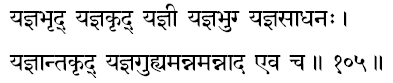
yaj~na-bhRt yaj~na-kRt yaj~nI yaj~nabhuk yaj~na-sAdhanaH |
yaj~nAnta-kRt
yaj~na-guhyam annam annAda eva ca ||
om yaj~na-bhRte namaH.
om yaj~na-kRte namaH.
om yaj~nine namH.
om
yaj~na-bhuje namaH.
om yaj~na-sAdhanAya namaH.
om yaj~nAnta-kRte namaH.
om
yaj~na-guhyAya namaH.
om annAya namaH.
om annAdAya namaH.
976. yaj~na-bhRt
He Who brings about the completion of the
sacrifice (even when there are imperfections in its performance).
om yaj~na-bhRte namaH.
The root from which the word bhRt is derived is bhR poshaNa
dhAraNayoH to hold, to support.
yaj~nam bibharti = pushNAti,
dhArayati iti yaj~na-bhRt He Who supports the sacrifice and brings
it to successful completion is called yaj~na-bhRt.
Sri BhaTTar notes that even
if there are deficiencies in the actual performance of a yaj~na, the final
offering of pUrNa Ahuti while thinking of Him,
results in the rectification of
all these deficiencies and the successful completion of the yaj~na
vikalpamapi yaj~nam sva-smaraNa pUrNAhutibhyAm pushNAti iti yaj~na-bhRt.
SrI
BhaTTar gives the following support from the Sruti:
pramAdAt kurvatAm karma pracyavatyadhvareshu yat |
smaraNAdeva tad-vishNoH
sampUrNam syAd-iti SrutiH ||
If there is a mistake in the performance of sacrifices due to
negligence or oversight, the sacrifice will become imperfect.
If the person thinks of vishNu for the removal of these deficiencies, they are removed and the sacrifice becomes perfect. This is what the Sruti declares.
SrI vELukkuDi kRshNan notes that the term bhRt suggests that bhagavAn bears the bhAram (burden) of completing the yaj~na successfully when the performer is unable to bear this burden for successful completion by himself. All the yajamAna has to do is to shift the burden for forgiving all the deficiencies at the end to bhagavAn by doing a pUrNAhuti. This is the final Ahuti that is offered, with divine thoughts at the Lotus feet of Lord kRshNa, asking for forgiveness for all the known and unknown, intended and unintended deficiencies in the performance of the yaj~na in order to ensure that the yaj~na as a whole becomes completed (pUrNam). The faults inherent in the performer of the yaj~na, the faults in the procedures, the faults used in the materials used in the offering, (deficiencies in mantra, tantra, vidhi, viparyAsa etc.), are all forgiven by bhagavAn when the final Ahuti is made with His Divine feet in mind. Among the mantra-s that are meditated upon at the time of pUrNAhuti are:
prAyaScittAnyaseshAni tapaH karmAnyAtmakAni vai |
yAni teshAm aSeshANAm SrI
kRshNAnusmaraNam param ||
upAcArApadeSena kRtAn aharar mayA |
apacArAn imAn sarvAn kshamasva
purushottama ||
pUrNAhutim uttamAm juhoti ; karmam vai pUrNAhutiH ;
AvirgIrbhiH yatatona Unam tena uktim vidhema
SrI Sankara reflects the same meaning in his interpretation yaj~nam bibharti pAti iti yaj~na-bhRt.
SrI rAdhAkRshNa SAstri notes that there
are four chief priests at any yAga, called Rtvija-s, and they ensure that all
steps of the yAga are performed correctly without any deficiency.
These priests
are called hotR, udgAtR, advaryu, and Brahman. At grand ceremonies, sixteen
priests are enumerated.
SrI cinmayAnanda continues his earlier interpretation of the term yaj~na, and
gives his interpretation for the current nAma as:
One Who helps us conclude
successfully all our good, dedicated, selfless acts of service to others.
977. yaj~na-kRt
He Who created the sacrifice.
om yaj~na-kRte namaH.
Both SrI Sankara and SrI BhaTTar give the interpretation that Lord
vishNu has this nAma because He created yaj~na as a means for the well-being of
the universe.
SrI BhaTTars interpretation is: jagad- hitAya yaj~namAdI
sRjati iti yaj~na-kRt
He first created the sacrifice for the
well-being of the Universe.
The following Sloka-s in the gItA explain in detail, in the words of Lord
kRshNa, the idea that bhagavAn created yaj~na as a means of establishing a
connection between the deva-s and the human beings:
saha-yaj~nAH prajA sRshTvA purovAca prajApatiH |
anena prasavishyadhvam esha vostvishTa kAma-dhuk || (gItA 3.10)
devAn bhAvayatAnena te devA bhAvayantu vaH |
parasparam bhAvayantaH SreyaH
param avApsyatha || (gItA 3.11)
ishTAn bhogAn hi vo devA dAsyante yaj~na bhAvitAH | (gItA 3.12)
In the beginning, the Lord of all beings, creating man along with the
sacrifice, said: By this shall you prosper; this shall be the cow of
plenty granting all your wants.
By this (yaj~na), please the gods, and the gods will support you. Thus
nourishing one another, may you obtain the highest good.
The gods, pleased by the sacrifice, will bestow on you the enjoyments
you desire.
In his explanation for the nAma vashaTkAraH, SrI rAdhAkRshNa SAstri
elaborates on this connection and interdependence between the deva-s and the
manushya-s as follows:
The deva-s depend on the manushya-s for their
havir-bhAgam through the yaj~na-s, and the people depend on the deva-s for their
sustenance through rain etc.
Thus, bhagavAn has set up the yaj~na as the bridge
between the deva-s and the people, and thereby the interdependence between the
deva-s and the manushya- s.
Therefore, He is called yaj~na-kRt.
The term yaj~na-kRt has also been interpreted as One Who is the
performer of yaj~na-s.
SrI cinmayAnandas translation for the nAma
is:
One Who performs yaj~na. He notes that the Lord issued forth
creation as an act of yaj~na a pure and selfless act of service to
the jIva-s.
SrI kRshNa datta bhAradvAj gives the interpretation:
yaj~nAn makhAn svayamapi karoti avatAra vigrahe iti yaj~na-kRt -
He
Who performs yaj~na-s Himself during His incarnations.
As has been noted in several previous nAma-s, Sri Sankara gives an
alternate interpretation for the term kRt as One Who destroys -
kRntati: jagadAdau yaj~nam karoti, tadante yaj~nam kRntati iti vA yaj~na-kRt
He Who created the sacrifices at the beginning, or He Who destroyed them at the
end of the universe.
>978.
yaj~nI – He for Whose sake the yaj~na-s are done.
om yaj~nine namaH.
SrI vAsishTha notes that the word yaj~nI is derived from the word yaj~na
by the addition of the ini pratyaya that has the same sense as
the matup pratyaya (one indicating possession) –
yaj~naH asya asti iti yaj~nI– He for Whom the sacrifices are performed.
SrI
BhaTTar's vyAkhyAnam is – sarva yaj~nAnam SeshI yaj~nI – He Who is the Lord
or Master of all the yaj~na-s. It is for His propitiation that all yaj~na-s are
performed.
SrI v.v. rAmAnujan refers us to the gItA Sloka 9.24 in support:
aham hi sarva yaj~nAnAm bhoktA ca prabhureva ca |
na tu mAm abhijAnanti tattvenAtaS-cyavanti te || (gItA
9.24)
"For, I am the only Enjoyer and the only Lord of all sacrifices.
They do not recognize Me in My true nature, and hence they fall".
SrI rAmAnujan also refers us to nammAzhvAr's tiruvAimozhi:
Seigaip payan uNbEnum yAnE ennum…. (tiruvAi. 5.6.4)
"Fruits of acts anyone does are but Mine".
SrI veLukkuDi kRshNan explains that this Lordship of bhagavAn
expresses itself in His ensuring that His devotee attains Him even
when any offering to Him is flawed and deficient. He illustrates
this point by taking five of toNDaraDipoDi AzhVAr's pASurams from tirumAlai,
starting with pASuram 25: (kuLittu mUnRanalai Ombum….).
AzhvAr
tells the Lord that he has not performed the karma-s ordained for his varNa,
he has not followed the j~nAna yoga or the bhakti yoga,
he has not spent any time singing the name of the Lord,
he has not done anything even remotely similar to the offering
of a flower like gajendra, he has not even offered the relatively
small service like the squirrels or the monkeys to Lord rAma, but the
only thing he knows is to cry for the help from the Lord. The Lord
accepts this as sufficient yaj~na, and takes AzhvAr to His Feet.
This
example is an excellent illustration of why BhagavAn is called
the Lord of all yaj~na-s. BhagavAn takes the offering of a flower by
gajendra, the offering of a few specks of sand by the squirrels, the
service offered by the monkeys, or the sheer cry for help from Him,
as a sufficient offering to Him, in order to bless His devotee.
(One
should remember that it is just sheer naicyAnusandhAnam that leads
AzhvAr to declare that he has no devotion of any kind, and has done
nothing to sing the name of the Lord).
Sri Sa'nkara's interpretation is:
"yaj~nAnAm tat-samAradhAnAtmanAm SeshI iti yaj~nI" –
He Who is the Principal (SeshI) of the yaj~na,
that is performed for His own adoration.
979. yaj~na-bhuk – The Enjoyer or the Protector of the
sacrifice.
om yaj~na-bhuje namaH.
yaj~nam bhu'nkte, bhunakti iti vA yaj~na-bhuk. The root used is
bhuj – pAlana abhyavahArayoH – to protect, to eat, to consume, to
enjoy. Thus, both the meanings (He is the Enjoyer, and He is the
Protector) are given. Both SrI Sa'nkara and SrI BhaTTar give both
the definitions.
SrI kRshNa datta bhAradvAj emphasizes the meaning bhu'nkte = aSnAti =
consumes, and gives the following interpretation: "ijyante dIyante
samarpyante svajanaiH iti yaj~nAH, arthAt nAnA-vidhA rucirAH
padArthAH | tAn bhu'nkte aSnAti iti yaj~na-bhuk" – He Who accepts
and enjoys the different kinds of offerings that are offered with
devotion by the devotees is ya~jna-bhuk. He gives support from the
gItA:
patram pushpam phalam toyam yo me bhaktyA prayacchati |
tad-aham bhaktyupahRtam aSnAmi prayatAtmanaH || 9gItA 9.26)
"Whoever offers Me with true devotion a leaf, a flower, a fruit or
some water, I accept this offering made with devotion by him with
pure heart".
It is worth recalling from the write-up for the previous nAma that
yaj~na is anything offered with sincerity, and that bhagavAn is ever
ready to accept even the simplest offering as long as it is made with
love, as we saw from the pASuram-s of toNDaraDippoDi AzhvAr, as
elaborated by SrI veLukkuDi kRshNan. The gItA Slokam quoted here
confirms the same point. SrImad SrImushNam ANDavan refers to the
gItA Slokam 9.24: "aham hi sarva yaj~nAnAm bhoktA ca prabhureva ca"
–
(I am the enjoyer and also the Lord of all the sacrifices".
For the current nAma, SrI kRshNan points out that the protection
aspect of yaj~na-s by bhagavAn is very well illustrated in His rAma
incarnation, where He protects the yAga by sage viSvAmitra. Anyone
who came in the way of the yaj~na was finished off by Lord rAma.
This is a vivid and visible case of protection of the yaj~na by
bhagavAn. For all the yaj~na-s performed, bhagavAn is the means, the
end, the One Who is worshipped, the One Who is the Object of worship,
and is also the One Who ensures the successful completion of the
yaj~na by protecting it from all obstacles. This is the significance
of the interpretation that "He is the Protector of yaj~na-s".
SrI cinmayAnanda makes another important point: "All that is offered
into the sacred Fire during a yaj~na, though with an invocation to
any of the deities, in tender devotion and with joy, goes to Him
alone, "The One receiver of all that is offered"".
980. yaj~na-sAdhanaH – a) He Who is an accessory for the
sacrifices.
b) He Who is attained through yaj~na-s as a means (or
sAdhana).
om yaj~na-sAdhanAya namaH.
The word sAdhana is derived from the root sAdh – samsiddhau – to
finish, to accomplish. SrI BhaTTar gives the interpretation – te
asya j~nAna-dvArA siddhyupAyA iti yaj~na-sAdhanaH – The sacrifices
become the means for attainment of the respective fruits only because
of the knowledge about Him. The emphasis is made that it is the
knowledge about bhagavAn, about the relationship between us and
bhagavAn – the Sesha-SeshI bhAvam or the servant-Master relationship,
and above all, the love with which the offerings are made to Him,
that are essential for the attainment of the fruits. It is not so
much the substance of what is offered that is important, but the
dedication behind it that is important, as has been emphasized
repeatedly earlier.
SrI baladeva vidyA bhUshaN's interpretation is along similar lines –
j~nAna dAnena yaj~na upakAritvAt yaj~na-sAdhanaH – Becaue He gives
the know-how for the performance of the yaj~na, and thus assisting in
the conduct of the yaj~na, bhagavAn is called yaj~na-sAdhanaH.
SrI veLukkuDi kRshnan starts with the definition of the term yaj~na
as "prApti upAyAH yaj~nam" - any means to attain Him is termed
yaj~na. Thus, the term does not just refer to the yaj~na performed
in a homa kuNDam, but covers any means of worshipping Him, including
the nitya tiru ArAdhanam performed for Him. The term sAdhanam refers
to upAyam or means to attain Him. SrI kRshnan points out that this
nitya ArAdhanam should be performed with SraddhA, and full dedication
to Him, and then bhagavAn acceptas this as means or uapAyam to attain
Him, and so He is called yaj~na-sAdhanaH.
SrI vAsishTha explains the nAma as – yaj~naH sAdhyate anena, yaj~nam
sAdhayati vA yaj~na-sAdhanaH – He through whom the yaj~na gets
accomplished, or He Who fulfils the yaj~na, is yaj~na-sAdhanaH.
SrI Sa'nkara explains the nAma as – yaj~nAH sAdhanam tat-prAptau iti
yaj~na-sAdhanaH – He is yaj~na-sAdhanaH because the yaj~na-s are a
sAdhana or a means to attain Him.
SrI kRshNa datta bhAradvAj notes that He is called yaj~na-sAdhanaH
because He enables the devotee to perform the yaj~na, and He is also
yaj~na sAdhanaH because He is attained through the yaj~na-s –
"yaj~naH pUjA ArAdhanam vA | tam bhaktAnAm sAdhayati iti yaj~na-
sAdhanaH | tathA yaj~naH pUjA sAdhanam prAptaye yasya iti yaj~na-
sAdhanaH".
Sri cinmayAnanda explains the nAma as: "One Who fulfils all ya~jna-
s. It is by His Grace alone that all noble endeavors, undertaken in
an honest and true sincerity, gain spectacular success". Notice
again that SrI cinmayAnanada interprets the term yaj~na in a broad
sense as "any effort undertaken for the public good, in a sense of
selfless undertaking".
SrI satya sandha tIrtha uses the meaning "means" for the term
sAdhana, and explains the nAma as "yaj~nasya sAdhanam sruk sruvAdikam
mantrAdikam vA yasmAt iti yaj~na-sAdhanaH" – He is called yaj~na
sAdhanaH since it is He who is the cause for the means such as the
ladle, the mantra-s, etc. used during the yaj~na. The terms sruk and
sruva refer to two different types of ladles used in the yaj~na
(sruva refers to the smaller ladle, and sruk refers to the larger
ladle in which the ghee is poured using the smaller ladle – Monier-
Williams dictionary). Lord kRshNa declares in the gItA that He is
the means for all the aspects associated with a yaj~na:
brahmArpaNam brahma haviH brahmAgnau brahmaNA hutam |
brahmaiva tena gantavyam brahma karma samAdhinA || (gItA 4.24)
"Brahman is the instrument to offer with; Brahman is the oblation.
By Brahman is the oblation offered into the fire of Brahman; Brahman
alone is to be reached by him who meditates on Him in his works".
Bhagavad rAmAnuja explains the term `brahmArpaNam' as a reference to
the means for offering in a yaj~na, such as a ladle – arpyate anena
iti arpaNam srugAdi, tad brahma kAryatvAt brahma, brahma yasya
havishaH arpaNam tad-brahmArpaNam.. - "That by which an offering is
given, such as a ladle, is an arpaNa. It is called Brahman because
it is an effect of Brahman, Brahman being the material cause of the
Universe. BrahmArpaNam is the oblation, of which the instrument is
Brahman…". This is the same idea that has been reflected by SrI
satya sandha tIrtha in his interpretation given above.
As if to illustrate that the devotees of the Lord can enjoy Him in
His infinite dimensions through their thoughts, Sri raghunAtha tIrtha
gives another interpretation – yaj~na SabdaH Subha-vAcI, tam
sAdhayati iti yaj~na-sAdhanaH – "The term yaj~na refers to
auspiciousness, and since bhagavAn gives auspicious results, He is
called yaj~na-sAdhanaH".
981. yaj~nAnta-kRt – He Who produces the fruit of the
sacrifices.
om yaj~nAnta-kRte namaH.
yaj~nasya antam = samAptim phalam vA karoti iti yaj~nAnta-kRt – He
Who brings about the successful conclusion of the yaj~na, or He Who
gives the fruits of the yaj~na. Thus, there are two approaches to
the interpretation of the nAma – One Who helps in the successful
conclusion of the yaj~na, or One Who gives the fruits of the yaj~na
at the conclusion of the yaj~na. Some interpreters have chosen both
the explanations, and others have chosen one of the two.
It should be remembered that yaj~na is a karma, and its goal is to
attain the true knowledge of bhagavAn, when it is performed without
material goals in mind. Sri BhaTTar's interpretation is that
bhagavAn is called yaj~nAnta-kRt since He makes the attainment of
true knowledge about Him as the end and the goal of all sacrifices –
yaj~na paryavasAnam sva-tattva j~nAnam karoti iti yaj~nAnta-kRt. (It
is well to remember here that in vedic parlance, `true knowledge'
about something means the conduct of one's life according to that
knowledge, and not the mere knowledge only). SrI BhaTTar quotes the
gItA in support of this concept:
SreyAn dravya mayAt yaj~nAt j~nAna yaj~naH parantapa |
sarvam karma akhilam pArtha j~nAne parisamApyate ||
(gItA 4.33)
"Of the two aspects of karma yoga – knowledge and material aspects,
the component of knowledge is superior to the component of material
sacrifices. O arjuna, all actions and everything else culminate in
knowledge".
SrI vELukkuDi kRshNan refers us to the Sruti vAkyam – "tamevam vidvAn
amRta iha bhavati | nAnyaH panthA ayanAya vidyate" – He Who realizes
that great Brahman attains the moksha Ananadam; there is no other
path to attain moksha. In other words, it is the knowledge about Him
that ultimately leads to moksha according to this Sruti vAkyam.
BhagavAn gives this knowledge as a result of the karma of yaj~nam,
and so He is called yaj~nAnta-kRt.
SrI Sa'nkara gives both the interpretations mentioned in the
introduction to the nAma: a) He Who gives the fruits of the yaj~na
at the conclusion of the yaj~na – yaj~nasya antam phala prAptim
kurvan yaj~nAnta-kRt; b) He Who brings about the successful
conclusion of the yaj~na with the chanting of the vaishNavI Rk or the
pUrNAhuti mantra as the final oblation – vaishNavI Rk-Samsanena
pUrNAhutyA vA yaj~na samAptim karoti iti yaj~nanta-kRt. The idea
that even when there are deficiencies during the performance of the
yaj~na, bhagavAn makes the yaj~na complete and successful with the
final offering of the last Ahuti dedicated to Him with pure thoughts,
has been explained earlier in nAma 976 – yaj~na-bhRt. SrI rAdhA
kRshNa SAstri quotes the following Sloka in support:
yasya smRtyA ca nAmoktyA tapo yA Su-kriyAdishu |
nyUnam sampUrNatAm yAti satyo vande tam acyutam ||
"Our prostrations to acyuta Who brings to successful completion any
good act, by the very thought of Him or the mention of His nAma".
SrI cinmayAnanda's explanation for the nAma is: "One Who performs
the last, concluding act in all yaj~na-s". He follows the lead of
SrI Sa'nkara in interpreting the nAma as a reference to the final act
of pUrNAhuti offering to the Lord, and notes that "when total
surrender of all vehicles and their actions is accomplished (in the
form of pUrNAhuti offering), the transcendental experience of the
Self, nArAyaNa alone, comes to manifest in all His divine Splendor".
SrI kRshNa datta bhAradvAj notes that the nAma signifies that
bhagavAn blesses the conclusion of the yaj~na by His very auspicious
appearance, out of His sheer Mercy – yaj~nAnAm anto ramaNIyo bhagavad-
AvirbhAvavelA | tamapi kRpayA karoti it yaj~nAnta-kRt | He gives
support from SrImad bhAgavatam:
yatra yaj~na-patiH sAkshAt bhagavAn harir_ISvaraH |
anvabhUyata sarvAtmA sarva-loka-guruH prabhuH || (4.19.3)
"The Supreme Deity, Lord vishNu, Who has everything and everyone as
His body, and Who is the Lord and Master of all, was offered
worship". (The subsequent Sloka-s, e.g. 4.19.6) describe bhagavAn's
actual appearance at the yaj~na, accompanied by the siddhas, kapila,
nArada, datta, etc.).
SrI satyadevo vAsishTha notes that the nAma signifies that bhagavAn
brings about the successful conclusion of the yaj~na by removing all
the obstacles, and also gives the fruits of the yaj~na to the kartA –
vighnAn vihRtya yo yaj~nam samApayati, sampAditasya tasya yaj~nasya
yo antam = phalam ca dadAti sa yaj~nAnta-kRt abhidIyate.
SrI baladeva vidyA bhUshaN chooses the meaning that bhagavAn decides
the final fruit of the yaj~na – yaj~nasya antam phala niScayam karoti
iti yaj~nAnta-kRt.
In an alternative interpretation, SrI satya sandha tIrtha uses the
root kR – himsAyAm – to hurt, to kill, and explains the nAma as "One
Who destroys or kills the likes of subAhu and mArIci, who tried to
put a premature end to the ya~na by viSvAmitra in the rAma
incarnation – yaj~nasya anto nASo yebhyaH te yaj~nAntAH subAhu
mAricAdayaH, tAn kRNoti it vA yan~nAnta-kRt.
982.
yaj~na-guhyam – He Who is the secret of the sacrifice.
om
yaj~na-guhyAya namaH.
The
word guhyam is derived from the root guh – samvaraNe – to cover, to keep
secret. Guhyam means `rahasyam' or secret. Different interpreters have given
their diverse anubhavam of how bhagavAn is the hidden secret behind yaj~na-s.
Sri
BhaTTar comments that bhagavAn is the `secret' behind the sacrifice, because not
everyone understands that He is the ultimate object of the sacrifice, and that
even though bhagavAn is not in need of any offering, He still feels satisfied as
if He has been long expecting the offerings, and enjoys them. Only those who are
wise and knowledgeable about the injunctions, the means and the fruits of the
sacrifices, realize this secret about Him; others do not realize this secret.
SrI BhaTTar quotes the following from the mahAbhArata in support:
sarve
vedAh sarva vedyAH sa-SastrAH sarve yaj~nAH sarva ijyaSca kRshNaH |viduH kRshNam
brAhmaNAs-tattvato ye teshAm rAjan sarva-yaj~nAH samAptAH ||
jyotIgmshi
SukrANi ca yAni loke trayo lokAH loka-pAlas-trayI ca |trayo'gnayaSca AhutayaSca
pa'nca sarve devA devakIputra eva ||
"All
the veda-s and all that has to be learnt, all the SAstra-s and all the
sacrifices, and all worship – all are SrI kRshNa. Those who know kRshNa
correctly this way, may be considered to have completed all the sacrifices
successfully".
"All
the shining luminaries in the universe, the three worlds, the three guardians of
the world, the three fires, and the five offerings in those holy fires, and all
the gods, are all SrI kRshNa, the Son of devaki".
The
above references bring out another subtle secret that is elaborated by SrImad
SrImushNam ANDavan: Even though the offering in a given yaj~na may be for some
of the other deities, the real Deity Who ultimately receives all the offerings
is BhagavAn and no one else. BhagavAn is the antaryAmi of all these other
deities, and while He feels satisfied with the offering, He also ensures that
these other deities are satisfied, and thus it is no one other than BhagavAn Who
is the ultimate object of all yaj~na-s. Not everyone who performs yaj~na-s
understands this, and thus bhagavAn is the secret behind the yaj~na-s in this
sense as well – yaj~na-guhyam.
Sri
VeLukkuDi kRshNan brings out another dimension to the anubhavam of this nAma:
Accepting the relatively meager offering in the yaj~na with great delight,
BhagavAn can give to the performer of the yaj~na, the benefit even up to moksham;
in other words, there is no limit to the return that He can bestow on the
performer of the yaj~na in return for the relatively trivial offering that
bhagavAn does not even need. This is a great secret that is not easily
understood by most people. He keeps the means of yaj~na as a great secret that
is understood only by a few who know the yaj~na SAstra properly, and so
He is yaj~na-guhyam.
SrI
rAdhAkRshNa SAstri notes that there are two aspects to any sacrifice – the
material aspects, and the thoughts behind the performance of the karma. We dealt
with this discussion under nAma 981 (gItA 4.33). Lord kRshna declares that the
thought behind the actions is more important than the act itself. When this
thought itself is dedicated to bhagavAn, in other words, when the thought behind
the yaj~na or offering is not one that aims at receiving some benefit for the
performer of the yaj~na, this is the best form of yaj~na. This is the secret
behind the performance of yaj~na-s in their ultimate true sense. When such
thought is the basis for the offering, this is a manifestation of Brahman
Himself, and so there is no difference between Brahman and the yaj~na or the
offering, and so He is called the `secret of the sacrifice' or the yaj~na-guhyam'.
This seems to be the meaning for Sri Sa'nakara's interpretation for the nAma –
yaj~nAnAm guhyam j~nAna-yaj~naH phalAbhisandhi-rahito vA yaj~naH; tad-abheda
upacArAt Brahma yaj~na-guhyam – "The secret of sacrifices is
`knowledge-sacrifice'. Yaj~na may also mean any deed performed without desire
for the fruit; Brahman, as identified with such deeds, is called yaj~na-guhyam".
SrI
cinmayAnanda explains the nAma as "The most profound truth to be realized
in all yaj~na-s". He elaborates: "The Self is the most noble truth to
be sought through `offering' all the dravya (objects) into the `consciousness'
(fire) in the `body' (kuNDa). This kind of subjective yaj~na is called in the
gItA as Knowledge-sacrifice ("j~nAna-yaj~na)". This is also called in
the veda-s as Brahma yaj~na".
SrI
baladeva vidyA bhUshaN reinforces the true spirit behind the performance of
sacrifices – It is for bhagavAn's pleasure alone, and not for any material
benefits for the performer, that the yaj~na is
to be undertaken, and so He is the secret behind the yaj~na-s – tena yaj~nena
tasyaiva mukhya uddeSyatvAt yaj~na-guhyam.
983. annam – The object of
enjoyment.
om
annAya namaH.
The
root from which the nAma is derived is ad – bhakshaNe – to eat. atti
= bhakshati iti annam – He who consumes or enjoys is `annam'. Alternatively,
adyaH iti annam – That which is consumed or eaten, is annam.
SrI
vAsishTha gives another alternate derivation using the root ana – prANane
– to breathe, to live: anIti iti annam, yadvA anyate = prANyate
yena tad annam – He Who makes the beings live, or He because of Whom the beings exist. This can refer to the vital air that
is necessary for the beings to
survive and live.
SrI
vAsishTha points out that the word `annam' is used in the Sruti to
refer to any offering in a yaj~na – that which can be offered as havis,
including ghRtam (ghee) etc:
SrI
BhaTTar explains the nAma as "bhoktR-SaktibhiH bhujyate iti annam'
– He Who is enjoyed, or is the Object of enjoyment by those who
have been blessed by Him with the power to enjoy Him. In fact, for the true devotee, everything except bhagavAn is not an
object of enjoyment, and He is
everything for them. SrI v.v. rAmAnujan refer us
to nammAzhvAr:
uNNum
SORu parugu nIr tinnum veRRilai ellAm kaNNan * emperumAn enRenRE kaNgaL nIl
malgi maNNiNuL avan SIr vaLam mikkavan Ur vinavi tiNNam en iLa mAn pugumUr
tirukkOLUrE. (tiruvAi. 6.7.1)
"To
His devotee, all is kRshNa. Food - eaten to satisfy the appetite,
water – drunk to quench the thirst, and betel leaves – consumed
after the food, are all kRshNa only in their case. Saying His name, speaking of His qualities, and thinking of Him, His
devotee will feel the hunger and
the thirst and all other needs satisfied. They
will not eat any other food since kRshNa-consciousness is enough food
for them. Reciting His name and enquiring everyone on the way "Am I on the
right path to tirukkOLUr? How far is it hence?” the
devotee will proceed without any other need for sustenance. The very thought of
His place serves as nourishment for the devotee".
SrI
rAmAnujan also refers us the gItA in support:
bahUnAm
janmanAm ante j~nAnavAn mAm prapadyate |
vAsudevas-sarvam iti sa mahAtmA sudurlabhaH || (gItA 7.19)
"At
the end of many births, the man of knowledge finds refuge in Me, realizing
that "vAsudeva is all" (annam). It is very hard to find such
a great-souled person".
The
well-known Sruti vAkya from taittirIya Upanishad:
aham
annam aham annam aham annam |
aham annAdo'ham annAdo'ham annAdaH
|
bhagavAn
is annam because He allows Himself to be enjoyed by those who
are qualified and endowed with the knowledge to enjoy Him. He in turn enjoys
those who thus enjoy Him, and so He is also called annAdaH
– Enjoyer (next nAma).
SrI
vELukkuDi kRshNan refers us to the pASurams of nammAzhvAr where AzhvAr
refers to both the aspects of bhagavAn being annam and annAdaH.
In the ten pASurams of tiruvAimozhi 5-10, AzhvAr repeatedly refers to both these aspects. We will deal with the references
for the nAma annAdaH under the next
nAma.
The
whole of divya prabandham is nothing but bhagavAn being enjoyed as
annam by the different AzhvArs. SrI kRshNan profusely keeps quoting
from different AzhvArs. Couple of examples are given below:
pAlAzhi
nee kiDakkum paNbai yAm kETTEyum kAl
Azhum ne'nju azhiyum kaN Suzhalum * neelAzhic cOdiyAi! AzhiyAi! tol vinai empAl
kaDiyum neediyAi! niR-cArndu ninRu. (nammAzhvAr periya tiruvantAdi 34).
"Oh
Lord! You have the brilliance of the dark Ocean, and You are the First
Cause of all the universes. It is Your nature to remove the blemishes
in the likes of me. When I think of You and the beauty of Your reclining in the Milky Ocean, the experience is so
profound that my legs are not able
to support me any more, my mind is not able to comprehend
Your beauty, and my eyes experience the same profoundness".
ERaDarttadum
EnamAi nilam kINDadum mun rAmanAi mARaDarttadum maN aLandadum Sollip pADi… (perumAL
tiru. Of kulaSekhara. 2.3)
"When
I sing Your glory – Your great feat of destroying the seven mighty
bulls, Your lifting the whole Earth in Your varAha incarnation,
Your destroying the evil rAvana in your rAma incarnation, tears of joy well into my eyes and overflow like
a river…..".
Sri
Sa'nkara explains the nAma as `adyate iti annam' = That which us consumed
by all beings is annam. Since He is the sustaining power present
in all the food consumed by all beings, He is called annam. SrI cinmayAnanda includes all the sense-objects that satisfy
the needs of the sense-organs under
scope of annam represented by Him, and
explains the nAma as "One Who has Himself become the sense- objects which
are the `food' consumed by the sense-organs".
Using
the definition atti = bhakshati iti annam – he Who eats, both Sri
Sa'nkara and SrI cinmyananda give the alternate interpretation that
He is called annam – One Who eats - atti bhUtAni iti annam – He Who
consumes everything at the time of pralaya.
SrI
kRshNa datta bhAradvAj uses the root ana – prANane – to breathe, to
live, and gives the explanation – anyante uapjIvyante bhaktAH yena sva-darSana-dAna
dvArA iti annaH – BhagavAn sustains the bhakta-s by giving them His darSanam, and so He is the Sustainer – annam.
The application of the uNAdi sUtra
3.10 adds the affix na after the root an,
giving the word annam – food.
SrI
baladeva vidyA bhUshaN extends the topic of yaj~nam that has been the
subject of the previous nAma-s to the current one as well, and explains
the nAma as indicating that at the successful conclusion of the
yaj~na by the devotee, when the devotee reaches the ultimate objectives
of SrI vaikunTham, bhagavAn presents Himself to the devotee in the forms of the most enjoyable objects in SrI
vaikunTham through His sa'nkalpa
Sakti, and so He becomes the ultimate annam for the devotee – yaj~na labhye parama vyomni yad-divya-rasa-
gandhAdikamadanIyam bhogyam.
984.
annAdaH � The Enjoyer of those who enjoy Him.
om
annAdAya namaH.
The
word annam can be derived from the roots ad � bhaksahNe,
or ana � prANane, as
indicated in the previous nAma, and one of the meanings is
food. To this word, the stem �Ada is added, to get the word annAdaH. This stem itself (Ada) is again derived
from the same root ad � bhakshaNe
� to eat, literally giving the meaning "The eater of food".
In the current context, the meaning is that BhagavAn is the Enjoyer
of those who enjoy Him. The previous nAma indicated that He is
One who is enjoyed by His devotees as annam, and the current nAma indicates
that He in turn enjoys the devotees who enjoy Him � annam atti
iti annAdaH.
SrI
BhaTTar's words in interpretation are: tAnSca tathA bhu'nkte iti annAdaH
� He is annAdaH since He also enjoys them in the same way as they
enjoy Him.
He
proceeds to explain the significance of the next two words in the Slokam
� eva and ca, which are not nAma-s of bhagavAn per se. He explains
that the significance of the word eva is that there is no one
else like Him � ko anya IdRSaH? iti eva-kAraH. The significance of
the word ca is that all that has been described thus far are present
perfectly in this one Deity, namely Lord vishNu � `ca' SabdaH sarvamuktam
ekatra asmin samuccinoti |.
SrI
baladeva vidyA bhUshaN echoes the same interpretation for the words
eva and ca �
na hyetAdRk anyo'sti iti bodhayitum eva-kAraH |
nikhila bhhogya samuccAya ca-kAraH
This
mutual love of the devotees to BhagavAn (He being annam), and for
bhagavAn to His devotees (He being annAdaH), is nicely described by
nammAzhvAr in his tiruvAimozhi pASuram 9.7.9, almost like a mutual competition
of who enjoys whom most, and is referenced by both SrI v.v.
rAmAnujan and by SrI vELukkuDi kRshNan:
vArik
koNDu unnai vizhu'nguvan kANil enRu ArvuRRa ennai ozhiya ennil munnam pArittu,
tAn ennai muRRap paruginAn kAr okkum kATkarai appan kaDiyanE. (tiruvAi. 9.7.9)
AzhvAr
says that he had been just waiting to see bhagavAn, and as soon
as He would see Him, his plan was to just swallow Him completely with
nothing left for anybody else. But even before that could happen,
bhagavAn planned more skillfully, and displayed His extreme sauSIlyam
to AzhvAr. This made AzhvAr melt down completely, and bhagavAn
just drank him totally in this `dravya' form. AzhvAr exclaims
that this tirukkATkaraiappan is an extremely hard nut to crack,
and One with whom no one can compete in this kind of game, or in
anything else for that matter. AzhvAr wanted to make Him annam, but
bhagavAn instead became the annAdan in this case.
SrI
Sa'nkara gives the meaning � annam atti iti annAdaH - "The
Eater of food" to the nAma,
and explains that the nAma signifies that bhagavAn
is the eater of the whole world as food. SrI Sa'nkara proceeds to explain the next two words eva and ca as follows:
-
sarvam jagat annAdi rUpeNa bhoktR-bhogyAtmakam eva iti darSayitum
eva-kAraH-
"The particle eva is used to show that the entire universe of becoming enjoyer and enjoyed, is traceable
to the Lord. -
ca SabdaH sarva nAmnAm ekasmin parasmin pumsi samuccitya vRttim
darSayitum �
The adjunct ca is used to indicate that all names ultimately
indicate a single Superior person. Another translation found
for Sri Sa'nkara's words is: The word ca is used to show that all
the names given in the text can be applied to the one ParamAtman.
SrI
rAdhAkRshNa SAstri comments that everything in this world can be classified in
two categories: food, and the eater of food. Through the nAmas annam and annAdaH for bhagavAn almost near the
conclusion of the stotra, SrI
bhIshma indicates to dharmaputra that vAsudeva who is seated in front of them is the One that has been described
all along through all the nAma-s
starting with viSvam, all the way up to the
current nAma. In the next Sloka, he states explicitly that Lord vishNu who has been praised in all the previous Sloka-s,
is none other devakI-nandana
kRshNa Who is seated in front of them.
The
concluding section of bhRgu valli in the taittirIya upanishad summarizes
that bhagavAn pervades food as well as the eater of food, and
so He is both of the form of annam and annAdaH � aham
annam annamadantamAdmi.
SrI
kRshNa datta bhAradvAj explains the nAma as � annam �
svajanopahRtam modakAni atti iti annAdaH � BhagavAn is called annAdaH
because He gladly accepts the
offerings from His devotees.
-dAsan
kRshNamAcAryan