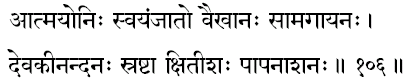
Atma-yoniH svayam-jAto vaikhAnaH
sAma-gAyanaH |
devakI-nandanaH srashTA kshitiSaH pApa-nASanaH ||
om
Atma-yonaye namaH.
om svayam-jAtAya namaH.
om vaikhAnAya namaH.
om sAma-gAyanAya namaH.
om devakI-nandanAya namaH.
om sRashTre namaH.
om kshitISAya namaH.
om pApa-nASanAya namaH.
985. Atma-yoniH – He mixes
with His devotees very easily.
The
root from which the word yoni is derived is yu – miSraNe amiSraNe ca
– to join, to separate. The affix ni is added by application of the
uNAdi sUtra 4.51, leading to the word yoni – womb. One explanation for the
nAma is AtmA = svayameva, svasya yoniH = kAraNam – He Who
is the Cause for Himself.
SrI
BhaTTar uses the root yu – `to unite, to mix', and interprets the
nAma as - "dughdeneva sitAvalayam AtmanA bhoktAram miSrayati iti
Atma-yoniH" - One Who mixes others with Himself easily like milk
with sugar. In other words, it is bhagavAn's sauSIlyam that is emphasized
by SrI BhaTTar through this nAma.
As
has been pointed out in many previous nAma-s, Sri BhaTTar's main emphasis in his
sahasra nAma vyAkhyAnam is to bring out the two guNa-s of bhagavAn that are of
utmost significance and importance to the devotees
– namely bhagavAn's sauSIlyam and saulabhyam. The
interpretation of the current nAma is a vivid example where SrI
BhaTTar uses his skills in interpretation to emphasize bhagavAn's guNa of sauSIlyam – or His ability to mix with His devotees
with the greatest ease, and let
them enjoy Him easily and completely, as long
as they are sincerely devoted to Him.
SrI
baladeva vidyA bhUshaN echoes the same thoughts as Sri BhaTTar in his
interpretation – AtmAnam svam yauti bhaktaH sahavAsa bhoge iti
Atma-yoniH – He Who mixes the bhakta-s with Himself
indistinguishably for the purpose
of their enjoyment of Him. He quotes the ananda maya
vidyA from Ananda valli of taittirIya upanishad –
"yo veda nihitam guhAyAm
parame vyoman |
So'Snute sarvAn kAnmAn saha |
brahmaNA vipaSciteti | -
"He who knows Brahman hidden in the cavity of the
heart,
enjoys in the supreme abode all the auspicious qualities of
Brahman
along with the all-knowing Brahman".
SrI
v.v. rAmAnujan refers us to nammAzhvAr's tiruvAimozhi pASuram
2.3.1 in support of SrI BhaTTar's interpretation:
Unil vAzh uyirE nallai pO unnaip peRRu vAnuLAr perumAn maduSUdan en ammAn
tAnum yAnum ellAm tannuLLE kalandu ozhindOm tEnum pAlum neyyum kannalum amudum
ottE. (tiruvAi. 2.3.1)
"O
my mind! Even though you are present in this physical body of flesh and the like
- all filthy, you have served me right in the direction of deliverance. What I have enjoyed is what
nityasUri-s enjoy in SrI vaikunTham.
BhagavAn has subdued me even when I was in
a mood to leave Him, and has made me a happy servant of His, and he
has become one with me. It is like honey mixing with honey, milk
with milk, sugar with sugar, ghee with ghee, and nectar with
nectar."
It
is worth noting that while SrI BhaTTar says that bhagavAn mixes with His devotee
like sugar and milk (see his vyAkhyAnam above), AzhvAr says bhagavAn has mixed
with Him like milk with milk itself (honey
with honey, milk with milk, ghee with ghee, etc.), a level
more intimate than the mixing of milk and sugar.
SrI
Sa'nkara brings out an aspect of bhagavAn's function of creation
through this nAma – Atmaiva yoniH – upAdAna kAraNam na anyat iti Atma-
yoniH – Because He alone is the material cause of the universe, and
no other, therefore He is called Atma-yoniH.
SrI
kRshNa datta bhAradvAj also gives the interpretation that since bhagavAn has no
cause other than Himself, He is called Atma-yoniH –
svambhUtvAt Atma-yoniH. He gives support from the Upanishad:
sa viSva-kRd viSva-vid Atma-yoniH (SvetASvatara. 6.16)
While
SrI kRshNa datta bhAradvAj gives the meaning svayam-bhU to the
word Atma-yoniH in the upnaishadic passage above, SrI N. S.
Anantara'ngAcArya translates the term as "indweller in the jIvAtman"
in his book titled "Selections from the Upanishads", and this translation is based on the vyAkhyAna of SrI ra'nga rAmAnuja
muni.
986. svayam-jAtaH � He
Who is self-born.
om
svayam-jAtAya namaH.
svayam jAyate ajanishTa iti vA svayam-jAtaH �
He Who is self-born, or is not
created by anyone else is svayam-jAtaH.
SrI
BhaTTar's anubhavam is that bhagavAn has this nAma signifying that
He takes His incarnations as and when necessary, without waiting for
those in difficulty to come and pray to Him to take His incarnation � prArthanA nirapekshatayA jAtaH
svayam-jAtaH. In other words, He
takes the incarnation out of His concern for the protection of
the good, the destruction of the evil, and the preservation of dharma
(paritrANAya sAdhUnAm, vinASAya ca dushkRtAm, dharma samsthApanArthAya
sambhavAmi) � He Himself takes birth out of His own will.
His main concern is the protection of the jIva-s that are His
children; it is His Nature to be concerned and to protect (kAkkum iyalvinan kaNNa perumAn � nammAzhvAr in
tiruvAimozhi 2.2.9), and so He
takes incarnations for this purpose as and when necessary, out of His own sa'nkalpam.
Repeated
reference has been made to the unique approach of SrI BhaTTar in interpreting
the nAmas by emphasizing that all that BhagavAn
does is for the benefit of His devotees. Even though the outward meaning for the
nAma is "One Who is born by Himself", SrI BhaTTar
takes the opportunity to point out that "He is born by Himself
as and when necessary to remove the sufferings of His devotees", rather than to just say that "Bhagavan
has no other Creator". The current nAma is one other instance of SrI
BhaTTar's unique anubhavam in his
interpretation of the nAma-s.
SrI
v.v. rAmAnujan quotes the tiruviruttam pASuram in support:
uyir aLippAn enninRa yOniyumAip piRandAi ! imaiyOr talaivA
| � (tiruviuttam 1)
"You
Who took birth voluntarily in order to liberate us from the burden
of samsAra".
SrI
vELukkuDi kRshNan gives a quote from the gItA in support, and notes
that bhagavAn gets entangled in the miseries of this world just to
release us from the same miseries:
na me pArtha asti kartavyam trishu lokeshu ki'ncana |
nAnavAptam avAptavyam varta eva ca karmaNi || (gItA 3.22)
"For
me, arjuna, there is nothing in all the three worlds which ought to
be done, nor is there anything unacquired that ought to be acquired.
Yet I go on working".
SrI
veLukkuDi kRshNan points out that it is for removing the bondage of
several other women that sItA pirATTi voluntarily lived for ten months
in the prison of the ten-headed rAvaNa, and it is for removing our
bondage that Lord kRshNa voluntarily chose to be born in the prison
of kamsa. For the Divine Couple, all these voluntary sufferings are for the purpose of relieving our sufferings.
In
his vyAkhyAnam for the above gItA Sloka, bhagavad rAmAnuja explains
that bhagavAn still continues to work for the protection of the
world, even though there is nothing for Him personally to be achieved
by working �
"karmaNA avAptavyam na ki'ncid api asti, athApi loka rakshAyai karmaNi eva varte".
SrI
Sa'nkara had explained the previous nAma (Atma-yoniH) as signifying
that bhagavAn is the Material cause of the Universe. He continues
this thread in the current nAma, and explains the nAma svam- jAtaH as signifying
that bhagavAn is also the Instrumental cause � nimitta
kAraNam api sa eva iti darSayitum svayam-jAta iti. The terms
`Material cause' and `Instrumental cause' can be briefly explained by reference to the making of a pot by a potter,
using the mud, the wheel, the water
etc. In this example, the mud is the upAdAna
kAraNa or the material cause. The nimitta kAraNa or the Instrumental
cause is the pot maker. The other supplementary materials
such as the wheel, the water etc. are called the sahakAri kAraNa-s. SrI Sa'nkara's interpretation for the previous and
the current nAma-s are that
bhagavAn is both the Instrumental Cause and the
Material Cause in the process of creation. He gives support from the brahma sUtra (prakRtiSca pratij~nA dRshTAnta
anuparodhAt (1.4.23)) that declares
that bhagavAn is not just the Instrumental cause
but also the Material cause. In other words, He performs the function of creation with no other help or external means but
from Himself, by Himself. This is
nicely captured by nammAzhvAr in his tiruvAimozhi
pASuram 1.5.4 (tAn Or uruvE tani vittAi tannil mUvar mudalAya�.).
SrI
rAdhAkRshNa SAstri explains the nAma as `One Who appeared by Himself",
and gives the reference from taittirIya upanishad in support:
tad-AtmAnam svayam akuruta � That Brahman created Itself by Itself
(Anandavalli in taittirIya upanishad). If it be said that devaki
`gave birth' to kRshNa, SrI Suka explains that bhagavAn just appeared from her womb just as the moon appears in the sky
� devakyAm deva rUpiNyAm
vishNuH sarva guhASayaH AvirAsIt yathA prAcyAm diSi induriva
pushkalaH (SrImad bhAgavatam 10.3.8). Lord kRshNa chose to enter
devaki's womb for some time, and then chose to come out when He chose
to come out; the connection between devaki and kRshNa is just the
same connection as between the east direction and the moon from which
it appears.
987. vaikhAnaH � He Who
uproots (the evils of the world).
om
vaikhAnAya namaH.
The
root from which the nAma is derived is khana � avadhAraNe � to dig.
vi- is an upasarga, and the sense in which it is used here is to
denote intensity (viSesheNa). The sense in which He `digs' is interpreted
differently by different interpreters.
Sri
BhaTTar uses the root khana with the meaning `uproot', and explains
the nAma as One Who uproots the miseries of His devotees � janitvA,
bhava duHkha vikhananAt vaikhAnaH � Having taken His birth or
incarnation out of His own will, then BhagavAn proceeds to uproot the
sorrows of the world, in particular the sorrow of repeated birth and
death.
SrI
baladeva vidyA bhUshaN follows a similar interpretation �
janitvAca sva-bhakta duHkha vikhananAt vaikhAnaH �
Taking birth voluntarily, He
destroys the sorrows of His devotees.
SrImad
SrImushNam ANDavaan refers us to the first pASuram of nammAzhvAr's
tiruviruttam, where AzhvAr points out that bhagavAn takes
His births for the purpose of removing our bondage to this samsAra:
poi
ninRa j~nAnamum pollA ozhukkum, azhukku uDambum in ninRa nIrmai ini yAm uRavAmai
uyir aLippAn en-ninRa yOniyumAip piRandAi!
imaiyOr talaivA mei-ninRu kETTu aruLAi,
aDiyEn Seyyum viNNappamE.
"O
Lord of the deva-s! You take Your births amongst us out of Your own
free will in order to protect us, who live with false and incomplete
knowledge, bad conduct, and an impure body and mind, and are
stuck deep in the ocean of samsAra. You alone can redeem us from this
deep misery. Please bless us and heed my plea and save us".
Sri
Sa'nkara uses the meaning `dig' for the root khana, and uses the instance
of bhagavAn's varAha incarnation to illustrate the significance
of the nAma �
dharaNIm
viSeshena khanitvA pAtAla vAsinam
hiraNyAksham vArAha rUpam AsthAya jaghAna
iti purANe prasiddham �
It
is well-known in the purANa-s that
He, in the form of a boar, dug up the
earth, and killed hiraNyAksha, an asura who lived in the netherworld.
Sri
cinmayAnanda gives an interesting interpretation for the above purANic
incident � hiranya is gold, and aksha is eye, and the term
`hiraNyAksha' symbolizes our eye towards materialistic pleasures. BhagavAn has to dig and reach inside our ego to rid
us of this desire for materialistic
pleasures, and in this sense He is vaikhAnaH.
*One
of the interpretations given by SrI satyadevo vAsishTha uses the meaning
`disturbance' for the term `khana'. Using the meaning
`devoid of' for the upasarga vi-, he interprets the term vikhAna
as a reference to the mukta-s who are completely liberated, and
then explains the term vaikhAna as the Lord of vikhAna-s or the mukta-s
� vikhAnAH khanana rahitAH muktAH, tatsambandhI vaikhAnaH.
SrI
raghunAtha tIrtha takes the word `khana' as meaning `to dig � to completely
undo', and interprets the nAma as � viSesheNa Satrum avadArayati
iti vikhAnaH, vikhAna eva vaikhAnaH � He who cuts into pieces and destroys the enemy.
Using
the meaning `dig' for the root khana, SrI vAsishTha gives another
interpretation, and attributes the existence of oceans etc., as
the work of the Lord � He has specially provided for these as examples of His specially digging out these resources of water
in nature, which no one else can do
�
tasya ca viSishThaH khAno samudrasya
_ nahIdRk khananam kenacit tad-anyena kartum Sakyam |
988. sAma-gAyanaH –
a) He before Whom the sAma hymns are sung.
b) He Who sings the sAma gAna Himself.
c) He Who is the final resort for those who sing the sAma gAna.
om sAma-gayanAya namaH.
The word sAma is derived from the root so – antaHkarmaNi – to destroy, to
bring to an end. By application of the uNAdi sUtra 4.152 (sAtibhyAm manin
maniNau), the word sAma is obtained, meaning `that which is appeasing'. The word
also refers to the sAma veda. The word gAyana means `singer' (derived from the
root gai – Sabde – to sing, and the pANini sUtra 3.1.153 – NyuT ca).
sAma-gAyana means one who sings the sAma, and sAma-gAyaNaH means One Who has the
singers of sAma hymns.
a) SrI BhaTTar uses the above interpretation and explains the nAma as
"One Who has the mukta-s or the Released souls singing the sAma hymns in
praise of Him once they have attained Him" – sva-prApti madhu pAnena
"hAvu hAvu hAvu" iti sAmAni gAyamAno muktaH asya asti iti sAma-gAyanaH.
He gives the quote from taittirIya Upanishad – "etat sAma gayannAste"
– (The released soul or mukta) will be singing this sAma chant….
SrI kRshNa datta bhAradvAj refers us to a passage in SrImad bhAgavatam where
the description is given about bhagavAn being worshipped through the sAma gAna
chanting:
yam brahmA rudrendra varuNa marutaH stunvanti divyaiH stavaiH vedaiH sA'nga
pada kramopanishadaiH gAyanti yam sAmagAH |
dhyAnAvasthita tad-gatena manasA paSyanti yam yoginaH yasyAntam na viduH
surAsura gaNA devAya tasmai namaH || (12.13.1)
"Our obeisance to Him who is worshipped by the likes of brahmA, rudra,
indra, and marut-s through the best of praises, through veda-s chanted
systematically with their a'nga-s and karma-s, whose praise is sung by those who
sing the sAma gAna, who is seen through the concentrated meditation of the
yogi-s, and whose infinite nature is beyond realization by the deva-s and asura-s,
and Who is ever resplendent".
Among the four veda-s, sAma veda is given special emphasis by Lord kRshNa:
vedAnAm sAma vedo'smi devAnAmasmi vAsavaH |
indriyANAm manaScAsmi bhUtAnAm asmi cetanA || (gItA 10.22)
"Of the veda-s I am sAma veda. Of gods, I am indra. Of sense-organs I am
the manas. Of living beings, I am consciousness".
b) Sri Sa'nkara attributes the singing of the sAman to kaNNan Himself, and
interprets the nAma as "One Who sings the sAma gAnam" – sAmAni
gAyanti iti sAma-gAyanaH.
SrI rAdhAkRshNa SAstri comments that the brahma j~nAni sings the sAma gAnam
in the excitement of his realization,
and Lord kRshNa in His incarnation sang in the flute the peaceful and
all-quieting sAma gAnam, and hence He is sAma-gAyanaH.
c) SrI satyadevo vAsishTha derives the interpretation for the nAma by looking
at the nAma as sAma + ga+ ayanaH.
Those who sing the sAma veda are called sAma-gAH. SAmagAnAm ayanam = ASrayaH
paramo lakshayaH sAmagAyanaH –
He Who is the final goal of those who sing the sAma is sAmagAyanaH.
SrI raghunAtha tIrtha explains the nAma as
"yaj~na vinASakAn rAkshasAn syati hinasti iti sAma gIyante asmin iti
gAyanaH |
sAmAni stotra viSeshAH gIyante asmin iti sAma-gAyanaH | -
"Extolled by special hymns of praises for His acts of killing the demons
who ruin the performance of the sacrifice".
989. devakI-nandanaH – The Source of joy to devaki.
om devakI-nandanAya namaH.
Recall that the whole vishNu sahasra nAma has been revealed to yudhishThira
by bhIshma in the presence of kRshNa. SrI BhaTTar's interpretation for the nAma
is that through this nAma, bhIshma is clarifying to yudhisThira that the nAma-s
that have been revealed all along are not about some Deity who is beyond reach,
but they describe none other than devakI-nandana who is seated just next to him,
and who has taken incarnation as the kinsman of yudhishThira. SrI BhaTTar refers
us to a Sloka from mahAbhArata:
sa esha pRthudhIrgAkshaH sambandhI te janArdanaH |
esha bhUtam bhavishyacca bhavacca bharatarshabha | ||
"O! Best of Bharata-s! JanArdana, the broad and long-eyed Lord is your
kinsman. He is all things in the past, the present and the future".
SrI Sa'nkara's interpretation is also along the same lines. He gives another
support from the mahAbhArata:
jyotIgmshi SukrANi ca yAni loke trayo lokA loka-pAlAS-trayI ca |
trayo agnayaSca AhutayaSca pa'nca sarve devA devakI-putra eva || (mahAbhArata
13, app. 1, 156-7)
"All the luminaries of the world, the three worlds themselves, the
protectors of the worlds by guarding the quarters, the three veda-s, the three
sacred fires, the five oblations are all but the Son of devaki (kRshNa)".
SrI kRshNa datta bhAradvAj gives the reference from SrImad bhAgavatam,
describing the incarnation of ParamAtmA as the Son of devaki:
devakyAm devarUpiNyAm devakI-nandanaH SrI kRshNaH |
AvirAsIt yathA prAcyAm diSir-induriva pushkalaH || ((bhAga. 10.3.8)
"Lord kRshNa, the Joy of devaki, appeared as the child of the divine
devaki just like the moon appearing from the eastern direction".
While the nAma devakI-nandana immediately reminds us of Lord kRshNa who was
'born' to devaki, a couple of interpreters have taken a different approach to
interpreting the nAma that does not refer to this incident of Lord kRshNa's
incarnation. A couple of these interpretations are included below as an example:
SrI raghunAtha tIrtha's interpretation is:
devAnAm kam sukham asya asti iti devakI somaH |
tena devakinA somena nandate iti devakI-nandanaH | -
"The term devaki refers to soma juice because it gives pleasure to the deva-s;
The Lord is called devakI-nandanaH because He is delighted by the offering of
soma juice". Or,
devena pAshANena kriyate sUyate iti devakI |
devakyA somena nandate iti devakI-nandanaH | -
"soma juice is extracted by the use of stones and so it is called devakI;
One Who is delighted by the offering of soma juice extracted through the use of
stones, is devakI-nandanaH". -
Sri satyadevo vAsishTha also avoids any reference to Lord kRshNa in this nAma,
and explains the nAma as a reference to sUrya. We will not go into the details
of how he gets this interpretation, but will only note that for some reason, he
also chose to not use the obvious interpretation that suggests itself for this
nAma, namely that the Supreme Deity Lord vishNu is none other than kRshNa who
was seated in the midst of the bhIshma and yudhishThira.
One can only speculate on why they chose to take this approach. One reason
could be that kRshNa chose to leave devaki within a few moments after He was
born to devaki, and so He was not a source of delight for devaki at least for a
few years after He was born. A few interpreters observe that another name
of yaSodA was devaki, and so He was a devakI-nandana (for instance, SrI
rAdhAkRshNa SAstri and SrI baladeva vidyA bhUshaN both make this observation).
Bhagavad rAmAnuja mentions in his SrI Bhashya, in the explanation of the mahA
vAkya `tat tvam asi', that "when a direct meaning of an expression is
sufficient, it is illegitimate to seek an indirect implied meaning – (SrI
AdidevAnanda's words in his Introduction to the translation of bhagavad
rAmAnuja's gitA bhAshyam). The 'indirect implied meanings' have been included
here for those with academic interest, and may kindly be ignored by the
bhAgavata-s of this group.
990. srashTA – The Creator.
Om srashTre namaH..
We studied this nAma earlier (Slokam 63 - nAma 595). Please refer to the
write-up for nAma 595 also.
sRjati iti sRashTA – vishNuH – He Who creates. As has been explained in
several places before, brahmA creates the things inside the brahmANDa, after
bhagavAn creates the things outside brahmANDa, and the brahmANDa itself with
brahmA inside the brahmANDa, and gives the power, the knowledge and the
responsibility to brahmA for the rest of the creation. It is because bhagavAn is
the antaryAmi in brahmA that brahmA is able to proceed with this function at
this point. Thus bhagavAn is the True Creator, as He is the Destroyer and the
Protector of all beings.
SrI BhaTTar reemphasizes through the interpretation for this nAma that SrI
BhIshma once more tells yudhishThira that devakI-nandana, SrI kRshNa, is none
other than para-vAsudeva who is responsible for creation. One can see bhagavAn's
saulabhyam and sauSIlyam reflected through these series of nAma-s. Even though
the reference to His function of creation can be taken to illustrate His
parattvam, the fact that the same para-vAsudeva has made Himself accessible to
all the people in the audience (where bhIshma is instructing yudhisThira on the
greatness of bhagavAn's nAma-s reflecting His kalyANa guNa-s) shows
simultaneously His saulabhyam.
SrI Sa'nkara bhAshyam is: "srashTA sarva lokasya" – BhagavAn is
called srashTA because He is the Creator of all the worlds.
SrI cinmayAnanda comments: "Even the creator (meaning catur-mukha brahmA)
can perform his job only by drawing his abilities and capacities from the
Infinite Self, SrI nArAyaNa". In other words, brahmA creates only because
bhagavAn is the antaryAmi of brahmA.
991. kshtISaH – The Lord of the Earth.
om kshitISAya namaH.
The root from which the nAma is derived is khsi – nivAsagatyoH – to
dwell. The application of the pANini sUtra 3.3.94 – striyAm ktin, leads to the
word khsitiH – the Earth; tasyA ISaH kshitISaH – The Lord of the Earth.
SrI BhaTTar notes that bhagavAn is the Lord of all the worlds, not just the
Earth, as revealed in the following reference:
yo anantarUpo akhila viSvarUpo garbhe'pi lokAn vapushA bibharti ||
"He is of infinite forms and is in the form of the entire universe. He
bears by His body all the worlds in His womb".
However, in this nAma, bhagavAn is particularly singled out as the Lord of
the Earth. Different anubhavam-s are given for this. SrI BhaTTar points out that
there is generally more suffering in the Earth than in the other worlds such as
the deva loka-s etc., and so bhagavAn takes incarnations more often here, to
help relieve the sufferings of the beings here. So He is particularly addressed
as the Lord of the Earth – kshitISaH - sarva ISatve'pi Arti- bhUyishThatvAt
bhUyishTham bhUmeH ISaH iti kshitISaH.
SrI veLukkuDi kRshNan refers us to the tiruvAimozhi pASuram 3.3.4, where
nammAzhvAr points out that even though bhagavAn is the Lord of the deva-s, He is
more attached to AzhvAr in this world more, because AzhvAr is in a more helpless
situation than the deva-s:
ESan vAnavarkku enban enRAl adu tESamO tiruvE'nkaTattAnukku nISanEn niRaivu
onRum ilEn en kaN pASam vaitta param SuDar SOdikkE. (tiruvAi. 3.3.4)
"We can declare that tiruvE'nkaTattAn is the Lord of nityasUri-s etc.
But this in no way adds to His glory. His true glory is in His mingling with the
lowliest of the lowly people like me, being accessible to all the downtrodden
etc. This, it is His saulabhyam that adds to His glory, and not the Lordship
over the nityasUri-s. He has shown a doting love to me, endearing me that
way".
It is this love of bhagavAn towards the suffering and downtrodden beings of
the Earth that makes them dear to Him, and so He is called the Lord of the Earth
in this nAma.. bhagavAn is "ISan" for all the other worlds, but His
"pASam" or love is with the Earth.
SrI baladeva vidyA bhUshaN also interprets the nAma as "Lord of the
Earth", the Lordship being reflected in His being concerned with the
removal of the suffering of the beings of the world and their protection –
kshiter-bhAram apanIyatAm pAlayana kshitISaH.
SrI Sa'nkara interprets the nAma as a reference to the rAma incarnation –
The Lord of the earth, the son of daSaratha – kshiteH bhUmeH ISaH
daSarathAtmajaH.
SrI cinmayAnanda interprets the nAma as "The Consort of Mother
Earth" – kshiti referring to Mother Earth or bhUmi pirATTi.
SrI satyadevo vAsishTha's interpretation is: Kshiyanti = nivasanti, gacchanti
vA nASam bhUtAni yasyAm sA kshitiH = bhUH, tasyA ISaH kshitISaH – That in
which all beings ultimately mingle after their life here, is kshitiH, or earth.
The Lord of kshiti is kshitISaH.
992. pApa-nASanaH – The Destroyer of sins.
Om pApa-nASanAya namaH.
pApam nASayati iti pApa-nASanaH. It is very interesting to look at the
derivation of the word pApa – it is derived from the root pA – rakshaNe –
to protect. The addition of the affix paH leads to the word pApaH – that from
which one should protect oneself is pApa, or sin. SrI vAsishTha gives the
derivation for the word pApa as "pAti asmAt AtmAnam iti pApaH – That from
which one should protect oneself is pApaH or sin.
SrI BhaTTar explains the nAma by reminding us of the great value of
meditating on bhagavAn's leelA-s. By meditating on the nectar-like stories of
His stealing the butter and curd, by reminding ourselves of His rAsa-krIDA-s
with the gopi-s, etc., the sins in our minds are removed. In fact, this is one
of the ways that bhagavAn annihilates the internal flaws in the minds of SrI
vaishNava-s – those who meditate on Him with single-minded devotion. SrI
BhaTTar's words are: atha dadhi-navanItastainya rAsa krIDAdi kathAmRtena
pareshAm pApa-nASanaH | avatAre'pi vaishNavAnAm bAhyAbhyantara Satru-nASanaH |
Even during His incarnations, He annihilates the enemies, both internal and
external, of SrIvaishNava-s (the devotees of vishNu inseparably associated with
SrI or mahA lakshmi). He annihilates the internal enemies when they meditate on
His kalyANa guNa-s, and he annihilates the external enemies through the divine
weapons that he carries for their protection (which is the substance of the next
and last Sloka)..
SrImad SrImushNam ANDavan explains that ordinary thieves only steal material
objects, but bhagavAn steals the feelings of stealth itself from the minds of
the devotees – the Stealer of the thought of stealth itself- cauryasya cauryam
jagati prasiddham – He is well- known as the Stealer of the very thought of
stealth itself from those who meditate on His leelA-s of stealing butter, curd
etc.
SrI v.v. rAmAnujan refers us to nammAzhvAr's tiruvAimozhi pASuram 3.6.2,
where AzhvAr refers to bhagavAn by the nama "pApanASan":
mUvarAgiya mUrtiyai mudal mUvarkkum mudalvan tannai SAvamuLLana nIkkuvAnai
taDam kDal kiDantAn tannai dEva dEvanai ten ila'nkai eri ezhac ceRRa villiyai
pAva nASanai pa'ngayat taDam kaNNanaip paravuminO. (tiruvAi. 3.6.2)
"I beseech all of you people to devote yourselves to the Lotus-eyed Lord
who is the Chief among the tri-mUrti-s, the antaryAmi of rudra and brahmA, and
their Creator. He is the One Who removes the curses of rudra, brahmA and other
gods whenever they get into trouble. He is the One Who is reclining in the Milk
Ocean, and the same One Who tortured the evil-minded ravAna and his SrI la'nkA
to retrieve sItA pirATTi. He is the Lotus-eyed Lord Who removes all our sins by
the mere contemplation on Him".
Similar thoughts are expressed by periyAzhvAr:
emmanA! en kula daivamE! ennuDai nAyakanE! nin uLEnAip peRRa nanmai
ivvulaginil yAr peRuvAr? namman pOlE vIzhttu amukkum nATTil uLLa pAvam ellAm
SummenAdE kai viTTo ODit tURugaL pAindanavE. (periAzhvAr tiru. 5.4.3)
"My Lord! How can I ever describe the great benefit that I have received
because of Your Grace? All the sins that normally push me down mercilessly to
the ground like demons and ghosts, have left me quietly like prisoners that
escape without making any noise and hide in the bushes".
SrI vELukkuDi kRshNan refers us to the gItA Slokam 4.9:
janma karma ca me divyam evam yo vetti tattvataH | tyaktvA deham punar-janma
naiti mAmeti so'rjuna || (gItA 4.9)
"He who thus knows in truth My divine birth and actions does not get
rebirth after this body; he will come to Me, O arjuna".
SrI kRishNan svAmi adds that if we meditate on His birth, we won't be born
again; if we meditate on His drinking His mother's milk in His birth, we won't
have to be born to drink a mother's milk; if we enjoy His leelA of stealing
butter and curd, our sins will be stolen away by Him; if we meditate on His
being bound by ropes by yaSodA, we won't be bound again in samsAra; such is the
greatness of the thoughts about Him and His leelA-s.
SrI Sa'nkara's vyAkhyAnam is: "kIrtitaH pUjito dhyAyataH smRtaH
pAparASim nASayan pApa-nASanaH" – He Who destroys the sins of those who
adore Him, meditate on Him, and remember and sing hymns of praise on Him. He
gives support from a work titled vRddhaSAtAtapa:
pakshopavAsAd yat-pApam purushasya praNaSyati | prANAyAma Satenaiva tat-pApam
naSyate nRNAm ||
prANAya sahasreNa yat-pApam naSyate nRNAm | kshaNa-mAtreNa tat-pApam
harer-dhyAnAt praNaSyati ||
"Whatever sins are removed by fasting for a fortnight, are destroyed by
performing a hundred prANAyAma-s. Whatever sins are destroyed by a thousand
prANAyAma-s, are removed in a fraction of a second by meditating on Hari".
SrI rAdhAkRshNa SAstri gives an explanation for how the thought of bhagavAn's
leelA-s is able to wash away one's sins. These thoughts of bhagavAn's leelA-s
have the effect of keeping Him always on our thoughts, and this is what causes
one's mind to be purified. This is what bhIshma tells yudhishThira at the
beginning of the stotra:
tasya loka pradhAnasya jagannAthasya bhUpate | vishNor-nAma sahasram me SruNu
pApa bhayApaham ||
"O king, hear from me the thousand names of vishNu, the Lord of the
Universe, the highest in the worlds; these remove all sins and fear". The
next stanza clarifies that the nAma-s are but representations of bhagavAna's
guNa-s – yAni nAmi gauNAni vikhyAtAni mahAtmanaH, and thus, meditation on the
names of vishNu, or the guNa- s of vishNu, leads to the removal of sins in the
mind of one who meditates on vishNu.
SrI kRshNa datta bhAradvAj gives support from SrImad bhAgavatam:
nAma sa'nkIrtanam yasya sarva pApa praNASanam | praNAmo duHkha SamanaH tam
namAmi harim param || (bhAga. 12.13.23)
"My prostrations to Lord SrI Hari Whose nAma sa'nkIrtanam leads to the
eradication of all sins, and by worshipping Whom all sorrows are weakened".
This is the last Slokam of SrImad bhAgavatam, and can be considered the
summarizing Slokam of SrImad bhAgavtam by SrI sUta muNi.
SrI cinmayAnanda summarizes the purport of the nAma in the following words:
"Meditating upon Whom all vAsanA-s (sins) are liquidated. When an
individual, surrendering in love to Him, acts and fulfills his duties, all his
existing vAsanA-s are destroyed, and no new ones are created. This is the very
root in the theory of karma yoga in the veda-s. Through meditation upon the
Self, all sins are dissolved and totally removed".
In one of his alternate interpretations, SrI satya sandha tIrtha looks at the
nAma as pApanAH + aSnAti – pApam nayati iti pApanAH daityAH, tAn aSnAti iti
pApaNASanaH. The asura-s are called pApanAH because they lead in committing
sins, and bhagavAn `eats away' or destroys these asura-s, and so He is called
pApanASanaH.
SrI baladeva vidyA bhUshaN also includes the above thought in one of his
alternative interpretations – pavitraiH caritaiH SrotRRNAm nikhila karmya
rUpam pApam vivartayan, asurAnAmapi nihatAn Atma vidyAm nivartya muktim tebhyo
yacchat pApanASanaH – He is called pApa nASanaH because He removes the sins of
those who hear the stories of His leelA-s; He is calo called pApa nASanaH
because He destroys the asura-s, and in the process, even for them He removes
their sins by redeeming the knowledge about the Self and gets them to moksha.
-dAsan kRshNamAcAryan