Audio

Sri Vishnu Sahasranamam - SLOKA 88
|
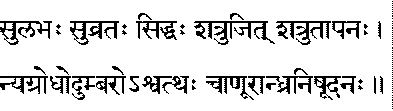
sulabhah su-vratah siddhah Satru-jit Satru-tApanah | om sulabhAya namah a) He Who can be easily attained. b) He Who makes it possible to attain sukham (sukham labhata). Om su-labhAya namah. su is a prefix (pratyaya) meaning sukham or saukaryam here. The root involvedin the nAma is labh – prAptau – to get. sukhena saukaryeNa vA labhyahsu-labhah – He Who is attained easily. In SrI viSishTAdvaita sampradAyam, His soulbhayam is one of the two mostimportant guNa-s that is enjoyed by the devotees very much (the other being HissauSIlyam). a) SrI BhaTTar's vyAkhyAnam is – anargho'pi mUlya-bhAsena svIkartum Sakyah– su-labhah – Even though He is priceless, He can be easily attained as iffor a small price. SrI BhaTTar gives the example of a woman of multi-defacedbody (kubjA) who offered some sandal paste to Lord kRshNa and got Him to visither house – She seized govinda by the dress and said "Come to myhouse": vastre pragRhya govindam mama geham vrajeti vai (vishNu purANam5.20.11). SrI v.v. rAmAnujan gives instances from AzhvAr's SrI sUkti-s: - pattuDai aDiyavarkku eLiyavan (tiruvAi. 1.3.1) – He is extremely easy ofaccess to those who approach Him with devotion. (After describing bhagavAn's parattvam in the first two tiruvAimozhi- s ofthe first pattu (decad), nammAzhvAr starts to describe His saulabhyam, and thisis the first pASuram of the third tiruvAimozhi, where he starts describing theincident where He just let Himself be bound to the mortar just to please yaSOdA.Tradition has it that nammAzhvAr was so moved by this soulabhyam of perumAL thatHe passed out at this simple, unassuming, virtue of emperumAn mingling with all,and was in this state of lost consciousness for six months before regainingconsciousness. That is the kind of anubhavam that the AzhvAr-s had of emperumAn.For those who have gone through ANDAL's nAcciyAr tirumozhi, to understandANDAL's outburst of emotion, it is important to understand that this is thelevel where she was in her anubhavam of perumAL). - eNNilum varum en ini vENDuvam (tiruvAi. 1.10.2) – if we count numbers andutter the number 26, He thinks we are referring to Him, and uses this as anexcuse to come to us. (Among the tattva-s, the twenty-fifth is the soul (jIva), and the 26th isparamAtmA. If someone counts numerals just for counting purposes, andaccidentally utters the number 26, He is willing to assume that this person isthinking of Him as the 26th tattvam, and is willing to appear before this personto bless him. Such is His willingness to be easily accessible). - aNiyan Agum tana-TAL aDaindArgatkellAm (tiruvAi. 9.10.8) - He is very nearto those who surrender themselves to Him. SrI v. n. vedAnta deSikan comments that when sugrIva surrendered to rAma forhelp in getting his kingdom and his wife, rAma considered it His supremeresponsibility to protect sugrIva above any other responsibility of His,including protecting sItA. Such is the power of surrender to Him. Lord rAmatells sugrIva: tvayi ki'ncit samApanne kim kAryam sItayA mama | bharatena mahAbAholakshmaNena yavIyasA | Satrughnena ca Satrughna sva-SarIreNa vA punah || (yuddha.41.5) "If you meet with death (by My lack of protecting you), I do not care ifany of the others are left behind – such as sItA, lakshmaNa, bharata,Satrughna, or for that matter, Myself". That is the level of His ease of accessibility through the simple act ofsurrender. SrI Sa'nkara's vyAkhyAnam is: patra-pushpAdibhih bhakti-mAtra- samarpitaihsukhena labhyata iti su-labhah – He Who is easily attainable even by the offerof leaves, flowers, fruits, etc., with full devotion. The key words are"with devotion". SrI Sa'nkara quotes from mahA-bhArata: patreshu pushpeshu phaleshu toyeshu akrIta-labhyeshu sadiava satsu |bhaktyeka-labhye purushe purANe muktyai katham na kriyate prayatnah || "The Ancient Purusha is easily attainable by devotion alone, with theoffer of leaves, flowers, fruits, and even water, which are always attainablewithout cost. When such is the case, how is it that people do not even want totry to work towards emancipation?" SrI cinmayAnanda quotes the gItA Slokam where bhagavAn Himself declares thatHe is "sulabhah": ananya-cetAh satatam yo mAm smarati nityaSah | tasyAham su-labhah pArthanitya-yuktasya yoginah || (gItA 8.14) "I am easy of access, O arjuna, to that yogin who is ever integratedwith Me, whose mind is not in anything else but Me, and who ceaselesslyrecollects Me at all times". b) SrI satya sndha yatirAja givea a new anubhavam – sukham labhata itisulabhah – He Who bestows happiness is su-labhah. a) He Who has taken a good, strong vow. Om su-vratAya namah. su is an upasarga (prefix). vrata means "promise, vow". a) SrI BhaTTar points to His su-vratam as "dRDha vratam" – strongvow. sakRdeva prapannAya tava asmi iti yAcate | "To him who has sought my protection only once, and begged of me saying"I am Thine", We also have His own assurances to bhagavad rAmAnuja in SaraNAgati gadyamabout how serious He is in His vratam: -anRtam nokta pUrvam me na ca vakshye kadAcana – sarva-dharmAn parityajya mAm ekam SaraNam vraja | - rAmo dvir na abhibhAshate – "rAma does not do double-talking". SrI v.v. rAmAnujan refers us to nammAzhvAr's tiruvAimozhi 9.10.5, whichreflects this su-vratam of bhagavAn: SaraNam Agum tanaTAL aDaindArgaTkellAm "The Lord grants SrI vaikunTham to whomsoever that has surrendered atHis feet. SrI v.v. rAmAnujan refers us to the following in SrI vacana bhUshaNam 381: b) SrI Sa'nkara associates the term vratam with consumption of food. HisvyAkhyAnam is: Sobhanam vratayati bhunkte. c) The alternate interpretation by SrI Sa'nkara is that He controlled what Heconsumed appropriately – d) SrI satyadevo vAsishTha views the term vratam as signifying control orrestraint – niyamanam, He gives the following references to the instance of His function of vrata orniyamanam from the Sruti: yasya vrate prithivI nannamIti yasya vrate Saphavaj- jarbhurIti | e) SrI baladeva vidyA bhUshaN gives the explanation that bhagavAn, in HiskRshNa incarnation, was observing all the vrata-s – rituals etc.,meticulously, and this is what is conveyed by this nAma – a) He Whose protection is ever available without any special effort on thepart of His devotees. om siddhAya namah. The root from which the nAma is derived is sidh – samrAddhau – to reach,to attain one's end, to succeed, to accomplish. We came across a series of nAma-sbased on this root in Slokam 27 – nAma-s 253 to 256 - siddhArthah,siddha-samkalpah, siddhi-dah, siddhi- sAdanah. In the current context, the nAmais interpreted as "One Who is already materialized as a Protector of us,One Who helps us materialize our objectives, One Who is perfect, One Who makesus perfect", etc. a) SrI BhaTTar's vyAkhyAnam is that His protection is available to Hisdevotees without any special effort on their part. The act of protecting Hisdevotees in natural to Him, is ever existent in Him, and is not conditioned byanything – SrI v.v.v rAmAnujan refers us to nammAzhvAr's tiruvAimozhi 5.7.10 in support: nammAzhvAr describes that bhagavAn is already materialized for our protection(siddhah) since He rushes to us to give us vaikunTham just for our chanting Hismany nAma-s: naNNinam nAraAyaNanai nAma'ngaL pala Solli "We approached nArAyaNa by reciting His names which are expressions ofHis qualities. The Lord comes and hastens to hand over SrI vaikunTha lokamitself to us, to enjoy at our will, whenever we wish it. He has come the wholeway through, taken residence near us in TiruvaTTARu, and waits, even though Heis in a great hurry to take me. O my mind! You were very co-operative;otherwise, this could not have happened". b) SvAmi deSikan explains that among the upAya-s or means for attaining Him,He is Himself the already existing siddha upAyam – siddhopAyastu muktauniravadhika dayah SrI-sakhah sarva-Saktih – SrIman nArAyaNa, with infinitemercy and infinite Sakti, is the siddha upAyam in the matter of bestowingmoksham (nyAsa vimSati 17) – the means that already exists without requiringany special effort on our part to create this upAya or means; all we need to isfollow one of the sAdhya upAya-s - either the bhakti or the prapatti mArgam, andHe is the pre-existing means (siddha upAya) that will grant the moksham. c) SrI Sa'nkara gives the interpretation that the nAma signifies that He isperfect – fully accomplished, without dependence on anyone else –ananyAdhIna siddhitvAt siddhah. d) SrI ananta kRshNa SAstry gives the interpretation that the nAma can alsomean that He is One who makes others perfect through their devotion to Him –The good ones attain perfection or full fruition in tapas, salvation, etc., byserving Him. SrI rAdhAkRshNa SAstri also gives a similar dual interpretation – He issiddhah because He gives siddhi to the practitioners of the vrata- s etc., andHe is siddha because He has attained siddhi in all respects. He gives supportfrom nRsimhottara tApanI 9.9 - sadevapurastAt siddham hi brahma. e) SrI satya sandha yatirAja gives a new interpretation – f) SrI kRshNa datta bhAradvAj gives the explanation that the nAma means thatbhagavAn is the Ultimate End or the Final conclusion of all enquiries –siddhyati sma siddhah – bhagavAn hi sakalaih pramANaih siddhah; tatrapratyaksham pramANam bhaktAnAm, anumAnam pramANam tArkikANAm, Sabda pramANam caSruti-SAstrANAm, evam pramANa- tryamapi Sri bhagavantam sAdhayati – For thedevotees, He is the prayaksha pramANam, for the analysts He is the final resultof the analysis, and He is the Sabda pramANam as declared loudly in the Sruti-sand SAstra-s. So He is the end result of all means of establishing the UltimateTruth. g) SrI satyadevo vAsishTha's anubhavam is that the nAma refers to "OneWho accomplishes everything there is to accomplish, with no effort" –Srama klamtandrAbhih varjito yatnApekshAsiddhiSca siddhah. Or, "He whoaccomplishes everything to completion and perfection always" is siddhah –sarvato bhAvinI SAsvatI siddhih asya iti siddhah. He refers to bhagavAn'screation of the universe and its functioning flawlessly, with the right mix ofair, heat, water, different species, etc., as He decides. SrI BhaTTar has interpreted the nAma-s in terms of bhagavAn's directincarnations. The interpretation of the next few nAma-s will be in terms of Hisindirect incarnations – that is, those in which He enters into others andacts. He Who occupies the bodies of Satru- jits to torment His devotees' enemies. Om Satru-jit-Satru-tApanAya namah. All interpreters other than SrI BhaTTar and those who follow him, treat thisas two nAma-s: Satru-jit and Satru-tApanah. The essential meaning of the twointerpretations is same – BhagavAn ensures that the enemies of the gods arepunished and conquered; either He Himself does this (SrI Sa'nkara'sinterpretation), as rAma, kRshNa, etc. in the case of rAvaNa, kamsa, etc., or Hedoes it by entering into someone else with His Sakti (sva-tejasA ApyAyitaih),and then accomplishes the destruction of the enemies of the gods (SrI BhaTTar'sinterpretation). Thus, SrI BhaTTar treats the nAma as Satru-jit-Satru-tApanah, and gives theexplanation that (in addition to using His powers directly in destroying theenemies of His devotees), He also uses His powers by entering into others withHis tejas, and then defeats the enemies of His devotees as well. Thus, hisinterpretation for this nAma is that He is Satru-tApanah (Torturer of Hisdevotees' enemies) by using Satru-jits (those who conquer their enemies) as Hisvehicle. SrI BhaTTar gives examples for this interpretation from SrI vishNupurANam: "para'njayo hi nAma SaSAdasya ca rAjarshes-tanayah kshatriya- varyah | "kakutsthah bhagavatah carAcaraguroh acyutasya tejasA ApyAyito "With a part of Me, I will descend into the body of para'njaya andannihilate the asura-s Myself". "…. Atha bhagavAn Adi-purushah purushottamo yauvanASvasya mAndhAtuhpurukutsa nAmA putrastam "The Adi-purusha and purushottama replied: I will enter into the personof purukutsa, the son of mAndhAtri and yuvanASva, and in him I will quiet theseiniquitous gandharva-s.".; "Reaching the regions below the earth, andbeing filled with the might of the Supreme Deity, he (purutkutsa) destroyed thegandharva-s". SrI satyadevo vAsishTha also gives this as his interpretation, the idea ofHis indirect incarnations, for the nAma satru-tApanah – sarva-suhRdah sAdhUndvishanti ta eva Satrvah, tAnSca yah sva- paradatta-Saktibhih mahA-purushaihtApayati iti Satru-tApanah – He gives His Sakti to the mahA-purushas, who inturn go after those who harm His devotees, and punish them. He gives the following support from atharva veda, where this guNa ofscorching the enemies is referred to: dvishas-tApayan hradah SatrUNAm tApayan manah | SrI kRshNa datta bhAradvAj treats the nAma as "Satru-jit-Satru- tApanah", The interpretation for Satru-jit and Satru-tApanah as separate nAma-s by SrISa'nkara and his followers is given below: Satru-jit: a) Satrum jayati iti Satru-jit – He Who conquers the enemy is Satru- jit.SrI Sa'nkara's interpretation is: sura-Satrava eva asya Satravah, tAn jayati itiSatru-jit – The enemies of the gods are His enemies, and He is the Conquerorof those, and so He is Satru-jit. b) SrI cinmayAnanda sees in this nAma the message that bhagavAn is the Onewho can drive away the worst of all the enemies, that in our mind: "In thebosom of man, his enemies are none other than consciousness of his body and theconsequent passions of the flesh – both objective and subjective. The seekerfeels that these urges in him constitute a very powerful team of belligerentforces, and against their concerted onslaught he feels helpless". But whenan alert seeker turns to nArAyaNa who is in his own heart, all obstacles whitheraway, and thus He is the "Supreme Conqueror of all enemies". In otherwords, it is the identification of the body with the soul that is the worst ofour enemies. Meditation on Him is the only means to conquer this enemy, and soHe is called Satru-jit. c) SrI satyadevo vAsishTha comments that bhagavAn displays His guNa ofconquering the enemy, by giving His creation different means to defendthemselves, such as the horns for the horned species, the nails for the lionetc., and other means for the other species to defend themselves. Satru-tApanah: a) SrI Sa'nkara gives the explanation – sura-SatrUNAm tApanAt Satru-tApanah – The Tormentor of the foes of the gods. SrI rAdhAkRshNa SAstri comments that this act of tormenting the Satru-sis to punish the evil-doers even when they are alive, by meting out severe andunbearable punishments to them. b) SrI cinmayAnanda continues along the lines of his interpretation for theprevious nAma, and comments that bhagavAn's nAma "Satru- tApana"indicates that "When the devotee offers himself at the altar of His Feet,He (bhagavAn) burns down all the negative tendencies polluting this devotee'sheart. He Who has the Supreme Abode with Lakshmi and everything that is magnificent,but Who is at the command of the devotees who approach Him with folded hands. om nyagrodhodumbarAya namah. This is another nAma which is treated as two separate nAma-s by mostvyAkhyAna-kartA-s except SrI BhaTTar and his followers. This nAma is anoutstanding example that illustrates the uniqueness of SrI BhaTTar's vyAkhyAnam.But first, let us look at the individual meanings of the two parts: nyagrodhah – SrI vAsishTha indicates the derivation of the word nyak from the root a'nc– gatipUjanayoh – to go, to worship. ni is an upasarga or prefix. nIcaiha'ncati iti nyak – One who bows low; The word rodhah is derived from the rootrudh, which has a couple of different meanings – rudh – kAme – to obey;rudh – AvaraNe – to oppose. The term nyag-rodah is also used to denote thevaTa vRksham – the banyan tree. Some vyAkhyAnakartA-s look at the nAma asnyag-rohah, using a grammar rule that says that the `ha' can be replaced by `gha'.The different interpretations are the results of the above variations. a) SrI BhaTTar's interpretation is: tvad-anghrim uddiSya kadA'pi kenacit yathA tathA vA'pi sakRt kRto'njalih | "If anyone worships Your Feet with folded hands even once at any timeunder any pretence, SrI v.v. rAmAnujan refers to the instance of His being tied to the mortar byyaSodA – "kaTTuNNap paNNiaya peru mAyan", as an example of thisSupreme ParamAtman being subservient to yaSodA's affection. b) In one if his interpretations, SrI vAsishTha uses the same roots, c) SrI Sa'nkara looks at the nAma as nyag-rohah for the purposes ofinterpretation, and then invokes the grammatical rule SrI satya sandha yatirAja also looks at the nAma as nyag-rohah (similar toSrI Sa'nkara above), but comes with a different interpretation. He uses themeaning ruh – to grow, and gives the explanation that the nAma signifies that"He makes all beings obey Him, and grows or develops all the beings"– sarvANi bhUtAni nyakRtya rohati vardhata iti. In the tamizh translation for SrI Sa'nkara's vyAkhyAnam by SrI kAmakoTi kOSasthAnam in 1948, one of the meanings given for the nAma is: "ellAuyirgaLaiyum kIzhp paDuttit tan mAyaiyAl mUDik kaTTup paDuttukiRAn" – ThenAma signifies that He controls all beings that are below Him, and envelops themwith His mAyA. This interpretation can be derived by using the meaning"below" for "nyak", and the meaning "obey" for theword rodhah (rudh kAme – to obey). d) The term nyagrodhah also refers to the banyan tree, since this tree growsin the downward direction as much as it grows in the upward direction. (ruh –to grow) – nIcair-gatau parohair-vardhate; nyag rohati – grows downwards.Because of this, this tree is very strongly rooted, and is extremely stable. SrIrAdhAkRshNa SAstri interprets the nAma as referring to this attribute ofbhagavAn, namely, that He is firmly rooted, and extends in all directions in theform of the universe. e) Another interpretation of SrI vAsishTha is – f) SrI baladeva vidyA bhUshaN gives the interpretation that g) SrI kRshNa datta bhAradvAj gives the interpretation: nyagbhih praNataihrudhyate hRdaya-pradeSe iti nyag-rodhah – He Who is desired in their hearts bythose who worship Him (rudh – kAme – to desire). udumbarah: a) He Who has the most auspicious SrI vaikuNTham as His own. ut is an upasarga (prefix). ambaram refers to the sky (derived from am –gati Sabda sambhaktishu – to go, to eat, to sound). ut + ambara = ud-ambara,which becomes ud-umbara because of a grammatical rule - pRshodarAdi lakshaNam. a) SrI BhaTTar's vyAkhyAnam is: sarva-guNaih udgatam ambaram – param dhAmaasya iti ud-umbarah – He Who has as the Supreme Abode, SrI vaikuNTham, isudumbarah. This abode is Supreme because it has Lakshmi, and it rises above allother things by its magnificent qualities (ut). b) SrI Sa'nkara's vyAkhyAnam is that "He is `above the sky' i..e., He issuperior to all – amabarAt udgatah ud-ambarah. SrI cinmayAnanda adds that the cause is subtler than the effect, and thus,the essential principle, nArAyaNa, transcends even the concept of space. c) SrI Sa'nkara gives an alternate interpretation using the meaning"food" for the word "Urk", and gives the explanation for thenAma as "Urk annam, tad-AtmanA viSvam poshayan udambarah – He Whonourishes the world in the form of food etc. He gives the support from Sruti –UrgvA annAd yad udumbaram (tait. brAh. 1.2.7, 1.3.8). d) SrI vAsishTha uses the root am – Sabde – to sound, and interprets thenAma ud-umbarah as "One Who has the best of sounds – the veda-s, as Hisform" – uccaih sarvata uttamo veda-rUpah Sabdo yasya sa ud- umbarahsarveSvaro vishNuh. e) Based on the same root, SrI vAsishTha gives another explanation – He Whois praised by the highest and best of sounds: bhajans, nAma- sa'nkIrtana-s etc.,– ut sarvata utkRshTatvena ambyate = Sabdyate = sa'nkIrtyata iti ud-umbarah. f) SrI kRshNa datta bhAradvAj gives the interpretation: ut utkRshTam ambarampItAmbaram yasya sah udumbarah - He Who has the superior pItAmbaram as Hisgarment is ud-ambarah. Here, he uses the word ambaram with the meaning"garment". nyag-rodha-udumbarah: Now that we have seen the separate meanings of the two nAma-s nyag- rodah andudumbarah, let us revisit the interpretation of SrI BhaTTar for this as one nAma.We note that SrI BhaTTar's explanation for the part nyag-rodah was that "bhagavAnis One who is subservient to the devotees who stand in front of Him with theirfolded hands", and for "udumbarah", the interpretation was that"He is One Who has the Supreme Abode as His, with Lakshmi and with all thatis magnificent". The reasons for combining the two into one nAma now standsout at us: "Even though bhagavAn is One Who is endowed with everything thatis Supreme, He is just at the command of His devotees when they stand in frontof Him with folded hands". SrI BhaTTar's words are: atyucchrita-sevyo'piatyanta-nIcAnAmapi anuvartana- sAdhyah – Though He is worshipped by thehighest of the gods, He is within easy reach of the lowliest of persons (becauseit is possible to please Him easily). No language or words can capture thissaulabhyaam of emperumAn. This nAma in SrI BhaTTar's vyAkhyAnam is perhaps oneof the best examples of the uniqueness of his contribution through hisvyAkhyAnam, appropriately titled as "bhagavad guNa darpaNam", where herepeatedly brings out the two supreme qualities of bhagavAn – His saulabhyamand His sauSeelyam. a) He Who has established the impermanent gods for performing variousfunctions. om aSvattAya namah. a) SrI BhaTTar's interpretation is based on looking at the nAma as a + Sva +stha (SrI aNNa'ngarAcArya). Svas means "tomorrow" (Apte's dictionary).a-Svah then means `not tomorrow', namely `that which is impermanent'. SrIBhaTTar interprets this as a reference to the impermanent positions of brahmA,indra etc. The part sthah refers to His being the niyAmaka or Controller of theworlds through these gods whose position is transitory – mUrtim rajo-mayIm brAhmIm ASritya sRjati prajAh | "Residing within the body of brahmA, composed of rajo guNa, bhagavAncreates the world. He takes the body of vishNu composed of sattva, and protectsthe world. Assuming the body of kAla (Siva) composed of tamo-guNa, He swallowsthe Universe". SrI v.v. rAmAnujan refers us to nammAzhvAr's tiruvAimozhi, where AzhvArdescribes this aspect of bhagavAn: iRukkum iRai iRuttu uNNa ev-vulagukkum tan mUrti "The lower deities, whom you are wont to worship for many differentworldly benefits, are like tax-collectors. They have all been established intheir positions by my Lord who is daiva-nAyaka, the Chief of all gods". In one of his interpretations, SrI satyadevo vAsishTha uses the concept oftime (Svas = tomorrow), and gives the interpretation: Svah = kAle, tishThati itiSvatthah, na Svatthah a_Svatthah, kAla bahir bhUto bhagavAn vishNuh – He Whois not constrained by time. This is why He is called sanAtana – Eternal,Permanent. He refers to the kaThopanishad passage b) One of SrI Sa'nkara's interpretations is based on the reference to theaSvatta tree – Urdhva-mUlam adhah SAkham aSvattham prAhur-avyayam | "They speak of an immutable aSvattha tree with its roots above and itsbranches below. The reference to the eternal aSvattha tree here is a reference to permanentcycle of samsAra, which is rooted in Brahman, and which grows in a continuousflow into the different life forms which themselves perish after some time, butthe flow continues on. It propagates through the knowledge in the forms of itsleaves. This knowledge (veda) consists of both the kAmya karma-s in the form ofreligious rites and sacrifices that promote the tree of samsAra, as well as theknowledge that is needed to fell this tree that grows by desire etc. The Sruti also gives the description of samsAra in terms of the aSvatthatree: - Urdhva-mUlo'vAk Sakha esho'Svatthah sanAtanah | (kaTho. 2.3.1) – c) SrI baladeva vidyA bhUshaN uses the meaning "prapa'ncam" or"the universe" for the word aSvattha, based on the niruktam – d) SrI satyadevo vAsishTha gives a different anubhavam. He derives themeaning starting from the root aS – vyAptau sa'nghAte ca – to pervade, toaccumulate. His interpretation is: aSnuvate – vyApnuvanti viSvam iti aSvAni– pa'nca mahA bhUtAni, teshu vyApakatvena sthitah aSvatthah – He Whopervades the entire universe in the form of the five great elements. a) He Who slew the wrestler by name cANura. Om cANurAndhara-nishUdanAya namah. a) SrI BhaTTar's interpretation is that this nAma refers to bhagavAn'sslaying of an asura wrestler by name cANUra, belonging to the andhra race, orone who is from a low-caste, and who was the enemy of indra and other gods –tad-virodhinam cANUra-nAmAnam asurAndhra mallam nishUditavAn iticANUrAndhra-nishUdanah. SrI v. n. vedAnta deSikan comments that this cANura isdifferent from the one that kamsa had deputed for killing kRshNa (it so happensthat this later was also a wrestler). The term andhra in this nAma is translated differently by the differenttranslated – either that it refers to a race called andhra, or a locationcalled andhra, or a low-caste called andhra. Some interpreters of SrI Sa'nkaravyAkhyAnam indicate that the cANura that was sent by kamsa was from the kingdomof andhra. b) SrI satyadevo vAsishTha derives his interpretation starting from the basicroots for the component parts of the nAma. - caN – dAne gatau ca – to give. caNanti = dadati dAna-SilAsAttvika-vRttayah cANUrAh – Those who are sAttvik by nature and who performacts of giving to others are called cANUra-s. Or, cAi – pUjA niSAmanayoh –to worship, to observe. cAyyante = pUjyante iti cANUrAh, praSasta-hRdayAhsAdhavah – Thus, SrI vAsishTha's interpretation for the nAma cANUrAndhra- nishUdanah is: c) SrI satya sandha yatirAja uses the pATham cANuRAndha nishUdanah, andinterprets the term andha to refer to duryodhana and his associates (andha meansblind; the reference to duryodhana and his associates as andhAh could be becausethey were blind to truth and dharma; it could also be because duryodhana and hisbrothers were sons of dhRtarAshTra). So his interpretation is that the nAmameans -dAsan kRshNamAcAryan
|