Audio

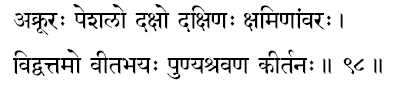
Sri Vishnu Sahasranamam - SLOKA 98
|
a-krUraH peSalo daksho dakshiNaH kshamiNAm-varaH | om a-krUrAya namaH 915. a-krUraH - He Who was not cruel (while rescuing gajendra). SrI vAsishTha indicates that the root from which the nAma is derived is kRt - chedane - to cut, to divide. Application of the uNAdi sUtra 2.21- kRtecchaH krU ca - The affix rak comes after the root kRt -to cut, and in one case, the verb is itself replaced by krU, leading to krUraH - wicked, cruel. na krUraH a-krUraH - He Who is not cruel, is a-krUraH. The best example of His disposition to be `not cruel' is His treatment of rAvaNa during the battle with him. When rAvaNa was all but defeated, and could have been finished with one more arrow, rAgahvan just told rAvaNa to go back to his home, rest and recuperate, and then come back refreshed the next day to continue the battle. Given the nature of the sin that rAvaNa had committed, the strength of the enemy, and the deceitful means that he employed in the battle, none but the kindest at heart would give `time to recuperate' for the enemy. In the context of the gajendra episode, bhagavAn was first kind enough to draw the elephant and the crocodile both from the waters to the shore safely, but did not kill the crocodile right away, even though He had His weapons in His hands - gajaparijigIrshayA karasthairapi AyudhaiH grAhamapi jhaTiti a-kRttavAn akrUraH. It is only when the crocodile refused to let go of gajendra even after being brought to the shore alive, that bhagavAn killed it. SrI kRshhNan comments that when He did ultimately kill the crocodile, He did not kill it with cruelty, but killed it instantly by splitting it into two, so that it did not suffer for a prolonged time in the process. SrI BhaTTar gives the following support: grAhagrstam gajendram ca tam grAham ca jalASayAt | "MadhusUdana, the Lord of inscrutable nature, quickly took out not only the elephant which had been seized by the crocodile, but lifted the crocodile also from the waters of the pond". Sri Sa'nkara first establishes a link between the mental state of cruelty and the desire of the mind, and the anger associated with unfulfilled desires. Then he notes that since bhagavAn is avApta samasta kAman - One Who has all His desires fulfilled, there is no room for anger in the mind, and no room for cruelty - SrI rAdhAkRshNa SAstri notes that in the hiraNyakaSipu episode, because the anger that bhagavAn had while slaying hiraNyakaSipu was `made up' anger and not natural, the moment the Lord saw prahlAda, His disposition immediately changed to one of love from anger. Thus, by nature, bhagavAn is a-krUraH. SrI baladeva vidyA bhUshaN adds another incident to illustrate that bhagavAn is, by nature, forgiving. He relates the durvAsa episode in the forest-life of pANDava-s, where the sage harassed the pANDava- s on behalf of duryodhana by demanding feast for a large battalion of his disciples after draupadi had washed her `akshaya-pAtra' for the day. In spite of this harassment to His dear devotees, Lord kRshNa did not harm him because, by His nature, He is akrUra - pANDava kleSa kArakam durvAsasam na kRtavAn iti a-krUraH. a) He Who is charming. om peSalAya namaH. SrI vAsishTha indicates the root for the nAma as piS - avayave, dIpanAyAm ca - to form, to kindle, to light, and the application of the uNAdi sUtra 1.106 - that adds the affix kala (ala) after the root. a) SrI BhaTTar explains the nAma as One Who was charming at the time of gajendra moksha, even with all His ornaments in chaotic condition because of the hurry in which He left SrI vaikunTham to help gajendra - sambhramAt ayathAyatha srag-bhUshAmbara ramaNIyaH - peSalaH. This association between the gajendra rakshaNam and bhagavAn's especially beautiful form at that time is beautifully reflected by nammAzhvAr in his tiruvAimozhi pASuram 3.5.1 (reference by SrI veLukkuDi kRshNan): moim-mAm pUmpozhil poigai mudalic ciRaippaTTu ninRa kaimmAvukku aruL Seida kAr mugil vaNNan .. (tiruvAi. 3.5.1) "To the elephant gajendra, that got into the trap of a crocodile while plucking a flower in the lotus-pond, our Lord kRshNa, with His dark hue reminiscent of the cloud, flew in a great haste displaying His condescending simplicity and grace". What is the connection between bhagavAn protecting gajendra, and His charming appearance (peSalaH)? SrI kRshNan has a few anubhavam-s on this. BhagavAn's beautiful appearance is a result of His feeling of happiness at having protected His devotee who was in distress. Or, His ornaments, dress etc., were very disorganized since He was in a hurry, and this itself was beautiful on Him - since the ornaments get their beauty by being associated with Him, and not the other way. SrI Sa'nkara's interpretation is that this nAma of bhagavAn indicates that He is handsome - peSalaH, because His deeds, mind, words, and body are all beautiful - karmaNA, manasA, vAcA, vapushA ca SobhanatvAt peSalaH. b) SrI rAdhAkRshNa SAstri comments that the nAma indicates "One with a soft heart, like a flower". He is One who is full of kindness and compassion, and this reflects in all His thoughts, words and deeds. SrI cimayAnanda comments: "In His Infinite kindness and Mercy, His Heart-divine is ever flowing out in love and tenderness towards His devotees when they call out for help ardently and lift themselves from their body-consciousness and egocentric life of sense-pursuits". SrI vAsishTha uses the meaning `piS - avayave - to form', and interprets the nAma as signifying that bhagavAn is One Who has formed or separated every major form in His creation (such as our human body) into its several parts - pimSati - avayavam karoti it peSalaH. He also gives examples of the nakshatra maNDalam being separated into individual stars, time being separated into its subdivisions, etc. SrI satya sandha tIrtha gives an alternate interpretation by looking at the nAma as pa + Isa + la: ISam = rudram, lAti = bhaktatvena gRhNAti, iti ISA-laH; pAti iti paH; paSca asau ISalaSca iti peSalaH - He Who has rudra who is devoted to Him, and He Who protects him, is pESalaH. a) He Who removes evil elements very quickly (daksh – SIghrArthe). om dakshAya namaH. We studied this nAma earlier in Slokam 45 (nAma 424). SrI vAsishTha derives the nAma from the root daksh – vRddhau SIghrArthe ca – to grow, to go in speed. The amara koSa vyAkhyAnam is “kAryam SIghram karoti iti dakshaH”. The different meanings for the word ‘daksha’ are given by SrI vAsishTha – pravRddhaH, SaktaH, SIghrakArI ca – One Who is grown(SrI Sa’nkara uses this meaning and interprets the nAma as “One Who has manifested Himself in the form of the Universe” – see below), One Who is skilled, and One Who is fast. The root daksh has also another meaning – gati himsanayoSca – to go, to hurt. The different interpretations are based on these different meanings for the word ‘daksha’. a) SrI BhaTTar explains nAma 424 in terms of the kalki incarnation, and how bhagavAn will get rid of the evil elements very quickly in this incarnation (dasyu-vadhe dakshate – SIghra-kArI iti dakshaH). One of SrI Sa’nkara’s interpretations for the instance of the nAma in Slokam 45 is - sarva karmANi kshipram karoti vA dakshaH - He Who performs all actions fast. The term ‘sankalapa mAtreNa’ is used extensively in describing this guNa of bhagavAn – All He has to do is to ‘will’, and the action will be done. b) For the current instance of the nAma, SrI BhaTTar gives the interpretation – kshipram AgantA dakshaH. This has been interpreted (translated) as “One Who came swiftly when called for by gajendra” by most translators, based on ‘daksh – SIghra-kArI’. SrI baladeva vidyA bhUshaN also gives his interpretation in terms of bhagavAn’s speed in responding when He is meditated upon – smRta mAtraH tvarayA gatavAn iti dakshaH. SrI kRshNa datta bhAradvAj also echoes the idea of the speed with which bhagavAn rushes to the protection of His devotee – dakshate = SighratAm kurute svajana avane iti dakshaH. Given that SrI BhaTTar’s bhAshyam for nAma 913 – SiSiraH, has already been interpreted as referring to bhagavAn’s speed in arriving at the scene where gajendra had called for help in pain, the above interpretation is redundant, and thus, is not the best interpretation for this instance in the writer’s opinion. It is to be noted that this is not punar-ukti dosham (fault of repetition) in the strict sense of the term , since different words (nAma-s) have been used by Sage vyAsa. This point is made by SrI Sa’nkara in his vyAkhyAnam for the next nAma, dakshiNaH, where he interprets the nAma ‘dakshiNaH’as having the same meaning as the current nAma – dakshaH. While the redundancy is thus not a case of punar-ukti dosham in the strict sense of the term, a better interpretation is provided by SrImad SrImushNam ANDavan, that removes this redundancy. He ‘translates’ SrI BhaTTar’s vyAkhyAnam for the current nAma as “One Who is skilled and has the power to arrive very fast”, based on ‘daksha – sAmarthya SAli or Sakti-SAli’. This point is discussed in detail near the end of the write-up for the current nAma. c) For the instance of the nAm in Slokam 45, using the meaning ‘daksh – to grow’, SrI Sa’nkara gives another interpretation – jagad-rUpeNa vardhamAnatvAt dakshaH - He Who grows into, or manifests Himself as, the Universe. d) For the current instance of the nAma, SrI Sa’nkara explains that since the Supreme Being has the three qualities – immensity, strength, and quickness in execution, He is called dakshaH – pravRddhaH SaktaH SighrakArI ca dakshaH | trayam caitat parasmin niyatiam iti dakshaH. SrI rAdhAkRshNa SAstri explains that He is deft in creation, and this is indicated by this nAma. SrI cinmayAnanda explains: “One Who undertakes creation, sustenance, and destruction of the whole Cosmos with ease and efficiency, diligence, and promptitude”. e) One of the alternate interpretations of SrI satya sandha tIrtha is: SatrUNAm hantA dakshaH – He Who destroys His enemies. This uses the meaning – daksh – himsanayoH – to hurt. This nAma provides a very good example of the difficulties in translating and interpreting the samskRt vyAkhyAnam of the great vyAkhyAna-kartA-s into other languages, and the possible errors that might be introduced in the process. The nAma-s “SiSiraH’ and ‘dakshaH’ occur almost adjacent to each other (nAma-s 913 and 917 respectively). SrI BhaTTar’s vyAkhyAnam in samskRt for the two nAma-s are: - SiSiraH – Arta-Sabda SravaNantaram ati-tvarayA gataH SiSiraH (SASa – pluta gatau; sAnnidhyam kalpayAmAsa tasmin saarasi)). - dakshaH – kshipram AgantA dakshaH. As explained under nAma 913, and based on SrI BhaTTar’s vyAkhyAnam, it seems clear that SrI BhaTTar had in mind the speed with which bhagavAn came to help gajendra. For nAma 917 – dakshaH, SrI BhaTTar refers to bhagavAn’s ‘speedy arrival’ (kshipram AgantA) again. The translators (two in English and two in tamizh) have translated both the above vyAkhyAna-s as referring to “One Who was very fast in coming to the help of gajendra)”. A couple of those who have elaborated on SrI BahTTar’s vyAkhyAnam even go to the extent of pointing out that ‘two nAma-s refer to the same incident’ - and thus the same guNaAnubhavam. Thus they have essentially attributed redundancy in Sage vyAsa’s narration, even though this is not punar-ukti dosham in the strict definition of this term, since different nAma-s are involved in describing the same incident. (See SrI Sa’nkara’s commentary for the next nAma, where he makes this point). SrImad SrImushNam ANDavan gives explains SrI BhaTTar’s vyAkhyAnam for the current nAma that eliminates this repetition, and thus, is a more elegant explanation of SrI BhaTTar’s vyAkhyAnam for this nAma. For the nAma SiSiraH, SrImad ANDavan gives the explanation of SrI BhaTTar’s vyAkhyAnam as a reference to “One Who came fast to the scene where gajendra had been seized by the crocodile”. But for the nAma ‘dakshaH’ (nAma 917), SrImad ANDavan explains SrI BhaTTar’s words “kshipram AgatA dakshaH”, as “One Who has the sAmarthyam as evidenced by His arriving at the scene very fast. (sAmarthyam = power, force, capacity, ability, strength – SrI Apte’s dictionary). Note that one of the meanings for the word ‘daksha’ is ‘dexterous, skilled’. Also, recall SrI vAsishTha’s words giving the different meanings for the word ‘daksha’ – SaktaH, Sighra-kArI ca – One Who has the power (SaktaH), or One Who achieves things fast (Sighra-kArI). Thus, SrImad ANDavan explains SrI BhaTTar’s vyAkhyAnam for ‘SiSiraH’ (nAma 913) in terms of bhagavAn being “SIghra-kArI”, and for “dakshaH” (nAma 917) in terms of bhagavAn being a “Sakti-SAli”. Thus the redundancy in the interpretation of SrI BhaTTar’s vyAkhyAnam does not exist any more. One could argue, mistakenly, that there is still redundancy in the interpretation of the nAma 425 (dakshaH), and the nAma SiSiraH (nAma 913), since both refer to His speed. But there is no redundancy in fact, since, for nAma 425, SrI BhaTTar refers to bhagavAn’s speed in getting rid of the evil people in His kalki incarnation, and for nAma 913, he is referring to BhagavAn’s speed in responding to the cry for help from a devotee. These are subtle points that may be of interest to some readers. SrI Sa’nkara avoids the punarukti dosham by giving interpretations that are distinctly different from each other, and thus there is no confusion in translating these: - SiSiraH – (based on “The cool season”) - tApa-traya abhitaptAnAm viSrama sthAnatvAt SiSiraH – He Who removes the torments arising from physical, mental and supernatural causes. - dakshaH - pravRddaH, SaktaH, SIghra-kArI ca – He Who is endowed with the qualities of immensity, strength, and quick execution. a) He Who is pleasing and amiable. om dakshiNAya namaH. The root from which the nAma is derived is the same as for the previous nAma - daksh - vRddhau, SIghrArthe - to grow or act quickly. The application of the uNAdi sUtra 2.50 -dru dakshibhyAm inan, results in addition of the affix inan to the root daksh, leading to the word dakshiNa. The siddhAnta kaumudI gives the following meanings for the word dakshiNaH - dakshate vardhate SIghrakArI bhavati vA sa dakshiNaH; saralo vAmabhAgaH paratantro'nuvartanam (right, honest, courteous, submissive). As explained above, the term `dakshiNa' has the same meaning as the term `daksha' - "dexterous, skillful, one who arrives fast, one who accomplishes things fast', etc., but additionally, it means `pleasing, amiable, courteous, civil', etc. (SrI Apte's dictionary). Thus, the word `dakshiNa' means `One who is fast, One who destroys, One who is courteous, One who grows His devotees, One who is compassionate', etc. a) SrI BhaTTar uses the meaning `courteous and compassionate' for the word `dakshiNa', and comments that even though bhagavAn responded immediately to the cry for help from gajendra, He still expressed regret to gajendra that He was not nearer to the site of the incident, and consoled gajendra with kind words. SrI BhaTTar's words are: thathA Agatya, `dhin'g mAm, dUragato'ham tvAm', iti sAntvanaiH, gajendrasya anukUlaH dakshiNaH - "Though He came as soon as gajendra called for His help, He still expressed regret that He was not near at the time of danger, and consoled gajendra with kind words - "Fie upon Me that I was far away from you". SrI BhaTTar gives support from vishNu dharma: prItimAn puNDArIkAkshaH SaraNAgata vatsalaH | "The Lotus-eyed Slayer of madhu, Who is kind and affectionate to those who have surrendered to Him, showed His love to gajendra, who worshipped Him". SrImad SrImushNam ANDavan explains the nAma as referring to His dAkshiNyam - politeness, civility, courtesy. For sarveSvaran to express regret to a mere animal, is a clear expression of His guNa of sauSIlyam. SrI kRshNan graphically describes that bhagavAn knelt at the feet of the elephant, checked for the injuries, took out His uttarIyam - the vastram at the top of His divya tirumEni, blew at it to get some heat, and then applied the heat to the elephant's leg to give comfort to the elephant's wound. In addition, He expressed regret for not having come earlier. This nAma thus illustrates that bhagavAn is SaraNAgata-vatsalan - One Who is dearly attached to those who surrender to Him. The word `sAntvanam' that has been used by SrI BhaTTar in his vyAkhyAnam means `consolation, pacification'. SrI kRshNan refers to another instance where bhagavAn felt `regret at having been late' - in helping the devotee who surrendered to Him' and expressed words of consolation - `sAntvanam'. This was in the case of vibhIshaNa SaraNAgati. `vacasA sAntvayitvainam locanAbhyAm pibanniva" - yuddha kANDam 19.7 - ""Lord rAma uttered words of consolation to vibhIshaNa, and blessed him with His kaTAksham, as if He drank vibhIshaNa through His eyes". b) c) SrI Sa'nkara comments that the meaning for the previous nAma and the current one are same, and notes that there is no punarukti by Sage vyAsa because different words have been used to describe this guNa of bhagavAn - dakashiNa SabdasyApi daksha eva arthaH; Sabda bhedAt na paunaruktyam. However, he proceeds then to give an alternate interpretation based on the root daksh - gati himsanayoH - to go or to kill - athavA, gacchati hinasti iti vA dakshaH - He Who goes or He Who kills is dakshiNaH. This is translated by SrI T. S. Krishnamoorthy as "One Who pervades everywhere", or as "One Who destroys everything" (e.g., at the time of pralaya - the function of samhAra). Using the meaning `to kill' or `destroy' for the root daksh, SrI baladeva vidyA bhUshaN gives the example of Lord kRshNa destroying or preventing the rise of duryodhana - damSati duryodhana udyamam iti dakshiNaH. d) SrI cinmayAnanda interprets the nAma in terms of dAkshiNya (liberal-hearted) - the opposite of selfishness and attachment to wealth that one possesses. He sums up the meaning of the nAma as "One Who has Infinite Kindness and Charity towards all good people and One Who is thus ever ready to liberally give away His endless Benevolence". He gives the example of the offering of `dakshiNA" to the priests after a ritual as their fee - this should be given in a spirit of large-hearted, liberal charity. Recall the nAma svasti- dakshiNaH (nAma 905 in Slokam 96), which is interpreted along these lines. SrI vAsishTha comments that bhagavAn is One Who arrives fast if one calls to Him for help, and is pleasant once He arrives - kshipram Agacchati AhUta, Agatya ca santushTo mukta-hastam dadAti iti udAraH sa dakshiNa ucyate. e) SrI kRshNa datta bhAradvAj uses the meaning - daksh -vardhate - to grow, and interprets the nAma as - dakshayati vardhayati svajanAn iti dakshNaH - He Who grows His devotees is dakshiNaH. f) An alternate interpretation by SrI bhAradvAj is - ata eva viSvara'nge udAratamo nAyakaH - BhagavAn is the most compassionate Lord of all. The amara describes `dakshiNa' as `sarala, udArau ca' - honest, sincere, generous, compassionate'. (amara. 3.1.8). a) The foremost in bearing the burden of protection of His devotees. om kshamiNAm-varAya namaH. The root of interest for the nAma is ksham - sahane - to allow, to suffer. vara is derived from vRN - varaNe - to choose. SrI vAsishTha explains the nAma as "sahana SilAyAm, kshmAvatAm madhye varaH = SreshTha ityarthaH", which has the above meaning. SrI Apte has listed the meanings `able, competent' for the word `kshama' in addition to `forbearance, patience'. The interpretations below use both these meanings. The nAma has been translated as "One Who is the best among those who have endurance", by most of the translators of SrI BhaTTar's vyAkhyAnam. However, the significance of SrI BhaTTar's vyAkhyAnam does not seem to be expressed well enough with this translation. Sri BhaTTar's words are - tad-darSanena dhRtAtmA; abhavat tatra deveSaH - It was only after seeing gajendra safe that He felt relieved; The Lord of all gods stood as though revived (after seeing gajendra safe)". This signifies that bhagavAn was throbbing with anxiety on behalf of His devotee and patiently putting up with this anxiety for the short duration between gajendra's call and His protecting gajendra. His desire to protect His devotee is so extreme and intense, that normally for Him to patiently wait till He comes to the scene of the incident was unimaginable. It is this extreme concern of bhagavAn - the intensity with which He is committed to the protection of His devotees, that is to be enjoyed here. It is the seriousness with which He takes His commitment to protect His devotee, and His anxiety at the smallest delay in protecting the devotee, that is enjoyed by Sri BhaTTar through this nAma - "BhagavAn is the Foremost in bearing the burden of protection of His devotee - kshamiNAm varaH". SrI kRshNan emphasizes this point, and refers to another incident where the Lord was throbbing with anxiety for the welfare of His devotee - when sugrIva suddenly rushed to rAvaNa and fought a duel with him, and brought the ten crowns of his ten heads. Lord rAma tells sugrIva after his return that He was very concerned about sugrIva's safety during that time, and added that for Him, sugrIva's safety was more important than even lakshmaNa or sItA pirATTi's welfare. Such is the intensity with which He bears the responsibility for the protection of His devotee. Of course, other anubhavam-s are possible for the nAma in the context of gajendra moksham, and some of these are given by some of the interpreters of SrI BhaTTar's bhAshyam. The most common among these is that bhagavAn did not lose His composure once He arrived at the scene of gajendra being caught by the crocodile (SrI M. V. Ramanujacharya's explanation - "gajendraniak kaNDa piRagu, tam manattaip padaikkAmal niRuttinavar"). SrI v. n. vedAnta deSikan comments that this guNa of bhagavAn was evident only after He saw that the elephant was safe (until that time, His concern for the safety of His devotee was extreme. b) SrI Sa'nkara gives multiple interpretations: - He Who is the foremost among yogin-s who have forbearance He gives support from SrImad rAmAyaNam - kshamayA pRthivi samaH (1.1.18) - Lord rAma's ability to endure is described as equal to that of Mother Earth. SrI cinmayAnanda's anubhavam is that bhagavAn has this nAma indicating that He is the most patient when it comes to tolerating and forgiving the sins of the jIvas. His words are: "He exhibits supreme patience with the evil-minded, the tyrant, the foul and the fiendish. hiraNyAksha, hiraNyakaSipu, rAvaNa, and others of this type were given many fair opportunities to realize for themselves the folly of their baser attitudes and their immoral ways of life. It is only when no other method of treatment could cure them that the Lord destroyed them in His Infinite kindness" (they all reached parama padam as a result of having His darSanam!). Another dimension of bhagavAn's forbearance is His willingness to forgive the sins of His devotees also One is reminded of the extent of sufferings that He subjected Himself to, during His rAma incarnation. The whole rAmAyaNa is a demonstration of His being kshamiNAm varaH, along with pirATTi, who is in all respects equal to Him. The incident of Sage bhRgu kicking bhagavAn in His vaksha sthalam, and the composed reaction of bhagavAn to this incident, is another example of His most superior kshamA or endurance and forbearance. SrI baladeva vidyAbhUshaN gives another example from Lord kRshNa's incarnation: The Best among those who know what to do. om vidvat-tamAya namaH. SrI vAsishTha gives the following derivation for the nAma - SrI BhaTTar interprets the nAma in terms of the gajendra moksham incident, and points out that the nAma reminds us that bhagavAn knew exactly how to administer treatment to gajendra as soon as He arrived at the scene - tac-cikitsAyAm vidvat-tamaH BhagavAn gently touched the elephant, and started speaking to the elephant comfortingly. Extreme devotion to bhagavAn is what caused gajendra to go to the pond to pluck the lotus flower for offering to Him in the first instance. Nothing was more important to gajendra than the darSanam of bhagavAn, and all his ailments were cured right away. (The beauty of the vyAkhyAnam of SrI BhaTTar, illustrating the extreme concern of bhagavAn to His devotees at every step, can only be felt, and cannot be described adequately through words. The current interpretation is one such example). SrImad SrImushNam ANDavan explains the nAma with the comment that bhagavAn is the `greatest Doctor there ever was and is, - the way He administered the most appropriate cikitasA or treatment to gajendra, (who had suffered for a thousand years in the clutch of the crocodile)'. BhagavAn knew precisely what would give gajendra the greatest comfort, and so He is called vidvat-tamaH in SrI BhaTTar's anubhavam. SrI BhaTTar gives support from vishNu dharma: evamuktvA kuruSreshTha! gajendram madhusUdanaH | The Bliss of the touch by bhagavAn's hands eliminates all misery, and is like the herbs that can cure any ailment. His divine hands were the medicine for gajendra, and the heat from His beautiful red lips were the comfort that gajendra would do anything to have. SrI veLukkuDi kRshNan gives another analogous example, where pirATTi administers the cikitsA that is the most appropriate for the occasion. tam dRshTvA Satru-hantAram maharshINAm sukhAvaham | "sItA pirATTi was extremely happy to see Lord rAma who had eliminated the rAkashas-s that were causing immense harm to the sages, SrI baladeva vidyAbhUshaN also interprets the nAma based on the gajendra episode - SrI rAdhAkRshNa SAstri generalizes SrI BhaTTar's explanation SrI Sa'nkara's interpretation is that bhagavAn has this nAma because He alone, and no one else, always possesses the knowledge of everything - SrI vAsishTha comments that bhagavAn is All-Knowing - a) He because of Whom fear is dispelled. om vIta-bhayAya namaH. SrI vAsishTha derives the meaning s "One Who has no fear" - SrI BhaTTar, whose special emphasis is the guNanubhavam of bhagavAn as One Whose sole purpose in everything He does is to help His devotees, gives the anubhavam that He has this nAma since He drives away the fear in His devotees - vItam bhayam yasmAt sa vIta-bhayaH. The former interpretation is given by SrI Sa'nkara and others who follow his vyAkhyAnam, and the later interpretation is given by SrI BhaTTar and those that follow his lead. a) SrI BhaTTar's interpretation is: tat-samAgama tumula upalambhAt vItam bhayam gajendrasya iti vIta-bhayaH - SrI veLukkuDi kRshNan's anubhavam is that gajendra was afraid that the lotus flower that he was carrying for offering to the Lord might become old and lose its freshness, and this fear waqs gone as soon as gajendra noticed that bhagavAn had arrived. SrI v.v. rAmAnujan comments that gajendra had called for help from nArAyaNa, and was afraid that bhagavAn's guna of ASrita rakshaNam might be questioned by some if He did not come right away, and it was this fear that was removed as soon as bhagavAn arrived. SrI baladeva vidyAbhUshaN echoes the same thoughts as above - vItam = vinashTam gajendrasya grAhAt bhayam yena sa vIta-bhayaH - He Who relieved gajendra of the fear of being gripped by the crocodile, is vIta-bhayaH. b) SrI Sa'nkara gives the interpretation - vItam = vigatam, bhayam sAmsArikam samsAra lakshaNam vA asya iti vIta-bhayaH, sarveSvaratvAt nitya muktatvAt ca - He Who has no fear pertaining to, or accompanying, the transmigratory life; in addition, since He is the Lord of all, and ever free, He I without fear of any kind as well.. SrI rAdhAkRshNa SAstri comments that the worst of all fears is the fear of samsAra, or being born in this world; since bhagavAn is beyond this, He is Fearless, and beyond fear - vIta-bhayaH. SrI satya sandha tIrtha also gives the explanation along the same lines - bhaya SUnyaH vIta bhayaH - One Who is without fear. Another dvaita AcArya, SrI raghunAtha tIrtha, gives the alternate interpretation that is supported by SrI BhaTTar - He Whose nAma SrvaNam and kIrtanam are purifying. om puNya-SravaNa-kIrtanAya namaH. The nAma can be understood in terms of its three component words: puNya, SravaNa, and kIrtana. puNya here refers to `that which purifies' - pavate, pUyate vA anena iti puNyam. SravaNa refers to hearing from others, and kIrtana refers to our own chanting. The nAma says that bhagavAn's glory is such that by hearing it from others, or by singing His glory ourselves, we will be purified. SrI BhaTTar continues his interpretation of the nAma as it relates to gajendra moksham, and explains the nAma as: "He by hearing whose gajendra moksham episode, or by narrating it ourselves, we get purified". This is one example of the purifying power of singing His glory or hearing His glory. SrI BhaTTar refers us to a Sloka from vishNu dharma in support: Srutena hi kuru-SreshTha! SmRtena kathitena vA | "O the best of kuru-s! A person is immediately rid of his sins if he hears, thinks or talks about the story of the rescue of gajendra by the Lord". SrImad SrImushNam ANDavan points out that bhagavAn is puNya SravaNa kIrtanaH also because He has thee kIrtanA (fame) that is worthy of being heard (SravaNa), and that will remove all our sins. He reminds us that this is the reason why we do the anusandhAnam of the following Slokam on gajendra moksham every morning as we get up: grAham graste gajendre sarabhasam tArkshaym Aruhya dhAvan vyAghUrNan mAlya bhUshA vasan parikaro megha gambhIra ghoshaH | The Slokam is found in devanAgari lipi in prakRtam SrImad Azhagiya Si'nger's Ahnika grantham. The Slokam reminds us how bhagavAn rushed to the scene of gajendra's suffering, climbing on to garuDa's back in a big hurry, with disheveled ornaments because of the hurry, with the roaring sound of His arrival clearly noticeable, and with all His weapons ready for the protection of the devotee. The anusansdhAnam (thinking with the meaning in our mind) of this act of bhagavAn will protect all those who meditate on it, chant it, or hear it from others. SrI baladeva vidyA bhUshaN echoes the same anubhavam - pApahAri- gajendra-sambandhi-SravaNAditvAt puNya-SravaNa-kIrtanaH. SrI Sa'nkara gives the following interpretation- puNyam puNyakaram SravaNam kIrtanam ca asya iti puNya-SravaNa-kIrtanaH - He, whose names, heard and recited, lead to religious merit. Both SrI Sa'nkara and SrI vAsishTha give reference to the phala Sruti Slokam which conveys the same message that is conveyed by this nAma: ya idam SruNuyAn-nityam yaScApi pariklIrtayet | "Nothing inauspicious or unwelcome will accrue either in this world or in the world beyond, to anyone who hears the vishNu sahasra nAma stotra daily, or who recites it daily". SrI cinmayAnanda comments that "kIrtana should not be just interpreted to mean mechanical repetition, but the serious student should reflect upon the glories of the Lord. We must learn to get ourselves committed to the life of God-centered activities. It is not to be a mere noisy chanting of hymns, a mere muttering of mantra- s. We must teach ourselves to allow Him to express through us. Our physical activities, mental feelings, and intellectual thoughts must all shine forth the awareness of His Divine Presence that is in us at every moment, everywhere. The life of such a devotee will itself become, in its dynamic beauty, love and devoted tenderness, a constant worship (poojA), a continuous (akhaNDa) hymn chanted (kIrtanA) in praise of the Lord-of-the-heart". The message should be self-explanatory. SrI vAsishTha summarizes the meaning of this nAma through the following composition of his own: yasyAsti nAmnAm SravaNam pavitram, sa'nkIrtanam cApyamalam hi tasya | "Lord vishNu, whose nAma-s are purifying to those who hear them or chant them - this Lord vishNu with His infinite nAma-s (representing His infinite kalyANa guNa-s), purifies this whole Universe through His nAma-s". -dAsan kRshNamAcAryan
|