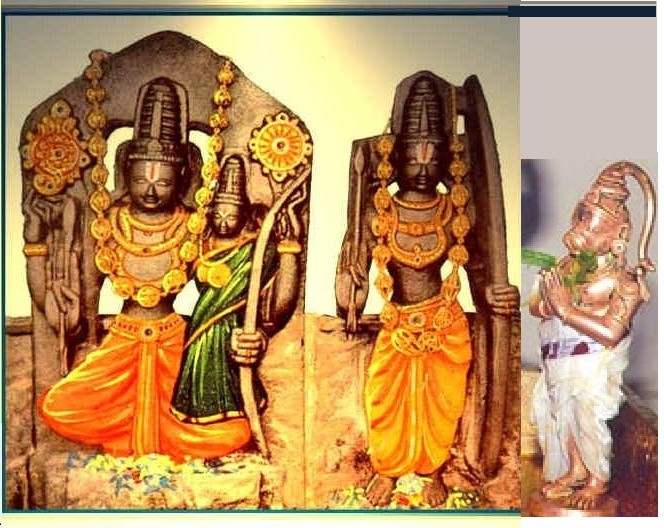
Bhadrachala Sri-Rama
PahiRamachandra by Musiri -audio
Allegorical meaning of the story in Sundara Kandam:
Sundarakandam is part of the great Ramayana Epic. There is hidden in it considerable allegorical significance:
- It can be viewed as the story of the awakened spiritual seeker, in search of the divinity within hidden by our ignorance.
- Hanuman is the awakened soul or intelligence
endowed with Sattva Guna. Jambhavan who kindled this awakening in Hanuman
by reminding him of his great strength is the enlightened spiritual teacher. - The crossing of the ocean is the crossing of the ocean of Samsara -- the eternal cycle of birth and death;
- The obstacles that Hanuman faced on the way are the obstacles that any endeavouring spiritual seeker has to face;
- The various mansions and
sense-attractions seen by Hanuman in Lanka in the course of his search, and
his passing through them
with complete control over his senses represent the various koshas or the various layers of the human mind
through which we have to penetrate; - Hanuman searched in the night, illustrating the
Sloka from the Bhagavad Gita which says:
"That which is night for all people is when the self-controlled sage is awake" - Hanuman's finding Sita Devi is the seeker’s ultimate success in finding the eternal spark of divinity that is within all of us.
 Sundara Kaandam is a mine of spiritual power, reading which
devotees can gain mental strength and spiritual support in complex worldly
situations.
Sundara Kaandam is a mine of spiritual power, reading which
devotees can gain mental strength and spiritual support in complex worldly
situations.
Its recital with faith will help one to get over difficulties and
gain success and welfare. The faithful devotee will become a spiritually
rejuvenated person;
his/her spiritual journey will take him/her closer to
the Supreme Personality of Godhead.
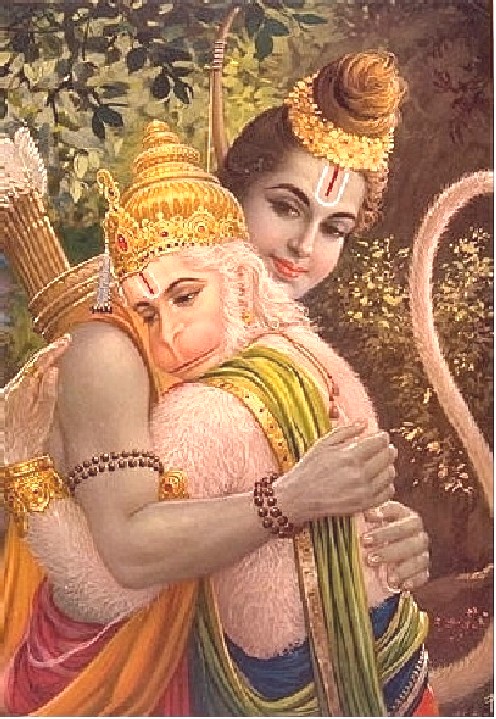
Hanuman is the hero of Sundara Kandam; he represents our spiritually evolved mind which is in communion with divine Rama; this theme is gloriously expressed with great devotion by the artist (unknown) in this picture:.
The sanskrit slokam quoted below (source not known) expresses what Hanuman thought of his relationship with Shri Ramachandra:
When Rama asked Hanuman: kastvam (who are you), he replied:
dEhabuddhyA tvadAsOsmi jIvabuddhyA tvadamshakaH |
AtmabuddhyA tvamEvAhamiti mE nishcitA matiH ||
The padArtha (word-by-word meaning):
dEhabuddhyA = by my physical (corporeal) self
tvadAsOsmi = tva dAsaH asmi = I am your servant
jIvabuddhyA = by my living (holistic) self
tvadamshakaH = tvat amshakaH = I am a part of you; I am a spark of your divine Self.
AtmabuddhyA = by my spiritual (innate/True) self
tvamEvAham = tvam Eva aham = I am thou
iti mE nishcitA matiH = such is my firm belief.
Chapter 21 of Sundara
Kandam describes the manner in which Sita Devi dealt with Ravana's advances in
the Ashoka-vana. Ravana attempts to
convince her of his superiority over Rama and offers inducements to tempt her;
he threatens her with dire consequences if she refused. Seetha replies to
Ravana advising that He should seek friendship with Rama and return Her back to
Rama. In the first two slokas of this chapter, Valmiki describes her mental
state and how she responds to him firmly. She first places a blade of grass
between her and Ravana and speaks to him rebutting his advances:
tasya tadvachanam shrutvaa siitaa raudrasya rakSasaH |
aartaa diinasvaraa diinam pratyuvaacha tataH shanaiH ||
1. siitaa= Seetha; shrutvaa= listening; tasya raudrasya rakshasaH= to that horrible ogre's; tat= that; vachanam= word; aartaa= being tormented; pratyuvacha= spoke in reply; diina svaraa= with a pitiable voice; diinam= pitifully; shanaiH= slowly.
Seetha listening to that horrible Rakshasa's words, being tormented, spoke in reply with a pitiable voice, pitifully and slowly.
duHkhaartaa rudatii siitaa vepamaanaa tapasvinii |
chintayantii varaaroha patimeva pativrataa ||
tR^iNamantarataH kR^itvaa pratyuvaacha shuchismitaa |
2. duhkhaartaa= Being tormented by grief; tapasvinii= in a pitiful state; varaarohaa= with excellent limbs; pativrataa= devoted to husband; chintayantii= thinking; patimeva= about husband alone; shuchi smitaa= with pleasant smiles; siitaa= Seetha; rudati=was sobbing; vepamaanaa= shivering; kR^itvaa= making; tR^iNam= a grass; antarataH= in between (herself and Ravana); pratyuvaacha= spoke in reply.
Being tormented by grief, in a pitiful state, with excellent limbs, devoted to husband, thinking about husband alone, with pleasant smile, Seetha was sobbing, shivering; placing a blade of grass between herself and Ravana, she spoke thus in reply.
. Smt. Vishaka Hari, in her HariKatha Kaalakshepam, explains the significance of Sita's action in placing a blade of grass: (click for audio of lecture)
 tR^iNamantarataH
kR^itvaa pratyuvaacha shuchismitaa |
tR^iNamantarataH
kR^itvaa pratyuvaacha shuchismitaa |
· As a chaste and devoted wife, she would not speak directly to Ravana; the grass represented a barrier, a curtain separating them.
· In valour, courage, noble qualities, Ravana was nothing (like grass) compared to Rama.
· The offer of wealth, status to Sita was of no value to her who was herself the goddess of wealth (Lakshmi)
· His offer of compensating her father Janaka was meaningless since he was himself a raja-rishi.
· His act of abducting her surreptitiously, by sending Rama and Lakshmana away and appearing as a mendicant, was not according to Rakshasa dharma even, which required that he win a willing virgin in combat.
· His behaviour towards her was like that of an animal – a cow which eats grass!
· Rama sent a blade of grass as Brahmastra to protect Sita from Kakaasura in the forest; this blade of grass should remind Ravana of Rama’s superior power.
· Sita herself can, if she chose, destroy Ravana with a blade of grass but desisted because his destruction was the purpose of Rama's avataram.
· As man-lion, Narasimha-avataram took place in a pillar. God can manifest Himself in anything, even in a blade of grass.
· Ravana lacked the sweetness, grace, compassion and strength of Rama (Tyagaraja’s kriti enta muddo). In that sense also, Ravana was like a blade of grass when compared with Rama. How dare he talk to her belittling Sri Rama!

· Sri Rama Pattabhishekam
A
condensed (samkshepa) version of Sundarakandam is available which may be accessed by clicking the links below:
Sankshepa Sundara Kandam:
Roman
Sanskrit
Audio(mp3)
(from: Shri Sundar Kidambi's http://www.prapatti.com/slokas/author/e-vaalmiiki.html
)
The
24 mts chanting in the Audio follows the traditional practice: commencing with
introductory prayer verses for about 8 minutes followed by
the Sankshepa
Sundarakandam and ending with Mangala Slokams.
Chanting this daily is considered
auspicious and Mangala Daayakam.
Sri
Rama Jayam.
Below is the hyperlink (URL) to an excellent site giving
all the 24,000 verses of Shri Valmiki Ramayanam.
Each chapter commences with a brief introductory note and each verse has been
rendered into Sanskrit, Romanized sanskrit and ITrans.
Each verse has Word by
Word meaning followed by its gist and explanation based on theism, culture,
literature as appropriate.
A great site, monumental labor of love and bhakti for Lord Sri Rama, Sita Devi and the devoted bhakta -
Hanuma.
You may access all this by clicking on the link: http://www.valmikiramayan.net .
An interesting interpretation of a famous slokam about the origin of Valmiki's Ramayanam from the above site:
maa nishhaada pratiSThaamtva | magamaH shaashvatiiH samaaH |
yat krau~Ncha mithunaat eka | mavadhiiH kaama mohitam || 1-2-15
15. ama= oh, ill-fate one; niSaada= oh, hunter; tvam= you; yat= by which reason; krau~Ncha+ mithunaat = of krouncha, couple; ekam= one; kaama+mohitam= in lustful, indulged in; avadhiiH= killed; [tat= by that reason]; shaashvatiiH= ever lasting; samaaH= ages to come; pratiSThaam+tu= reputation, but; maa+gamaH= don't, get.
"Oh! Ill-fated Hunter, by which reason you have killed one male bird of the couple, when it is in its lustful passion, thereby you will get an ever-lasting reputation for ages to come..." [1-2-15]
This is a celebrated stanza of Sanskrit literature, and controversial too, in deciphering its meaning. The separation of compound tvamagama = tu, ama, gamaH. We are told that this is the first verse of human origin with metrical rules and grammar. Earlier to this, only Vedic stanzas were available with their complicated compositional rules. This is the verse where this epic, Ramayana is said to have triggered off. The above given meaning is just the dictionary meaning. This verse has many other comports two of which are given hereunder:
1] This verse is taken as
maðgal˜caraõa to Ramayana, for any epic has to have maðgala
˜dIni maðgala madhy˜ni maðgala ant˜ni
[A good pious beginning, pious middle and pious ending.] Thus this verse
has the letter maa at its start and maa
is lakÿmi v˜caka in
Sanskrit. It is ˜di varõa× The
first letter - loka m˜t˜ m˜
ram˜ maðgala devat˜ thus amara kosha says for Goddess Lakshmi.
m˜=
Goddess Lakshmi; niÿ˜da=
Oh! Vishnu [ for Goddess Lakshmi resides in the heart of Vishnu -
niÿadIti asmin iti niÿ˜da]; yat
= by which act; krounca
midhun˜t = the couple of demons, namely Ravana and Mandodari; k˜ma
mohitam= that impassioned one and stole Seetha; ekam=
that one, Ravana; avadhI=
you killed; by that act of yours þaþvatIsam˜=
everlasting for ages; pratiÿ÷˜m=
divine sanctity;
tvam agama= you, get.
"Goddess Lakshmi's abode... Oh! Vishnu, by which act of your killing one male demon named Ravana, who in his passion abducted Seetha, and thus you eradicated the vice from the earth, for that you get an everlasting divine sanctity, as Rama, for ages to come."
2] The generally accepted meaning of this verse is this. Any
epic's gist is to be said at the start or, at its commencement ---
k˜vya artha s¨canam
kascin ˜dy˜m eva nir¨pyate --- Thus the above verse included the
meaning of whole of the epic, Ramayana.
i] maa+niSaada= Goddess Lakshmi and Vishnu's marriage in their incarnations as Rama and Setha - depicts -- Bala Kanda.
ii] pratiSTaam+tvam+agama= renown, you get - by following your father's orders you have repaired to forests, without any political upheaval, thus get an everlasting renown as an obliging son --- depicts-- Ayodhya Kanda.
iii] shashavatii+ samaa= by dwelling in forest and eradicating demons and helping the saints and sages thus, you achieve an everlasting praise - depicts - Aranaya Kanda.
iv] krounchayoH= from the atrocious couple; -- krunca gati kau÷ily˜ alpI bh˜vayo× ; the atrocious Vali, and Tara couple; ekam+kaama+mohitam = one, passion filled, i.e., Vali, avadhii= you killed Vali - depicts - Kishkindha Kanda.
v] krouncha +mithunaat= from the couple of lovely passionate birds - here Rama and Seetha; niSaada he Ravana, kaama mohitam lustfully, ekam one [i.e., Seetha]; avadhii = almost killed, i.e., her residing in Lanka is as good as death; this depicts - Sundara Kanda.
vi] krouincha+mithunaat = from the atrocious, couple - Ravana and Mandodari; ekam avadhii one - Ravana, is killed - depicts - Yuddha Kanda.
vii] kaama+mohitam= by desire, fascinated [ kama also means a longing, desire, let alone lusting]; Seetha is fascinated by her desire to see sage's wives in uttara Ramayana and thus she is left in hermitage by Lakshmana. Hence vii canto uttara Ramayana is also suggested.
Valmiki Ramayana in the Devanagari script is also available at:
http://acharya.iitm.ac.in/mirrors/vv/literature/ramayana/rama.html
Another site from which the points for the note on allegorical signifiance were taken is: MaruthiPramanam.htm