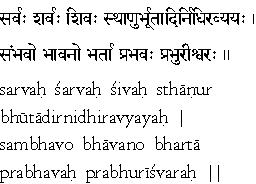

One who is all - the cause of creation and destruction of all things.
We have the following from MahAbhArata -
"asatasca satascaiva sarvasya prabhavApyayAt
sarvasya sarvadA jnAnAt savamenam pracakshate (MB 5.68.11)
"He is the origin and end of all things, chetana and achetana,
and He has full knowledge of all beings at all times, and so He is
called sarva".
Sri ChinmayAnanda gives a very simple illustration to help
understand the concept behind this nAma. - "All waves arise from
the same ocean, and so the ocean is the essence in all waves".
The Remover of all sins
I am unable to get a good understanding of the interpretation of
this nAma. The word is derived from the root sr - to tear to pieces,
to kill, to hurt. Neither Sri Bhattar nor Sri Sankara have given
references to other srutis for this nAma. If any of you know of a
context in the Gita or elsewhere that this name occurs or is referred
to, please advise me since I would like to understand the significance
of this nAma better.
Sri Bhattar's vyAkhyAna says that the Lord is called sarva because
He removes the evils of objects that are His body (sva sarIra bhUtAnAm
asubhamapi srNAti iti sarvah). Perhaps this means that BhagavAn
destroys the sins of His devotees, but the significance of the word .
"asubhamapi" in the above is unclear. The author of Nirukti
interprets Sri Bhattar's above vyAkhyAna as follows: "sva sarIra
jagad-duhkham sarva: sa sthAt srNAti yah"- Sri Sankara interprets
this word in terms of the action of BhagavAn at the time of pralaya in
withdrawing all beings unto Himself - srNAti samhAra samaye samharati
samhArayati vA sakalAh prajA: iti sarvah. In this context, SrI
RadhAkrshNa Sastri points out that this destruction at the time of
prlaya is not really to be considered cruel, since this is like
"destroying" the shape of raw rice when it is cooked in
order to make it edible - the beings are destroyed in order to give
them new life. (Another example: The caterpillar dies, and a
butterfly is borne. - MKK)
One who confers auspiciouness
subha Avahasca sivah - One who bestows auspiciouness on all.
In Mahabharata Drona Parva (202), we have the following for
supporting the above interpretation:
"sameghayati yan-nityam sarvArthAn sarvakarmasu |
sivamicchan manushyAnAm tasmAdesha sivah smrtah ||
"One who bestows all that is desired always by all His
devotees is called Siva because of this guNa of His".
Two instances of Sri VishNu being referred to as Siva are in
nArAyaNa upanishad -
"sAsvatam sivam acyutam" - The Eternal, The Auspicious,
and the One Who never lets His devotees fall"
"sa brahma sa sivah sendrah so'ksharah paramah svarAt" -
He is Brahma, He is Siva, He is Indra, He is Eternal, He is Supreme,
He is the Lord of all.
One who is .firm in His benefits and anugraha to the devotees.
The name derives from the word stha - tisThati, indicating firmness
or steadiness. Sri Bhattar interprets this name as indicating that the
result of BhagavAn's anugraha is firm in its effect of blessing the
devotee far beyond what other lesser acts can bestow.
Sri Radhakrishnam Sastri indicates that sthANu is also the name for
a tree which has matured to such an extent that no changes affect it
any more, including sun, rain etc. He interprets this name as
indicating BhagavAn's guNa of not being affected by changes such as
growth, decay, etc., nor impacted by the changes of time, place, etc.
We will revisit the name sthANu again in the sloka "vistArah
sthAvarah sthANuh.....", where we should expect a different
interpretation for this guNa in the context that is applicable at that
part of the stotram.
a) One who is eagerly sought after by all beings
b)  The source or cause of all beings
c)  The very source of the panca bhUtas
Sri Bhattar gives the interpretation bhUtaih sprhaNIyatanatayA
AdIyate - One who is eagerly sought after by all beings. Sri Sankara
gives the interpretation bhUtAnAm Adi-kAraNatvAt bhUtAdih - BhagavAn
is called bhUtAdih because He is the first cause of all beings. It is
possible that Sri Bhattar chose to interpret it differently because
the second interpretation is similar to the meaning for bhUtakrt (nAma
5). I would like to request any of our bhaktas to comment further.
Sri ChinmayAnanda gives another plausible interpretation . - The
very cause for the first five great elements - the panca bhUtas -
Space, Air, Fire, Water, and Earth. BhUtAnAm Adih
30. nidhiravyayah
The inexhaustible treasure.
Avayayah nidhih - He is like the wealth that is kept under safe keeping and
always available at the time of distress to His bhaktas. Sri ChinmayAnanda
points out that the term nidhi means that in which precious things are stored
away or preserved secretly - nidhIyate asmin iti nidhih. Surely BhagavAn is a
treasure that is not understood or obtained easily by everyone.
Sri Sankara interprets this nAma as meaning that VishNu is the One
in whom all things go and lie merged therein temporarily till the next
creation, and so He is the Immutable Treasure Chest.
31. sambhavah
(Though like a Hidden Treasure), One who manifests Himself at will
to .those who sincerely seek Him.
He manifests Himself at any place and at any time and in any form
(e.g., nrsimha, matsya, kUrma, etc.).
Note the following: "dharma samsthApanArthAya sambhavAmi yuge
yuge" (GItA 4-8)" svecchayA sambhavAmyevam garbha duhkha
vivarjitah"
32. bhAvanah
(Having manifested thus), One who regenerates all by dispelling all
their evils.
The author of Nirukti summarizes Sri Bhattar's interpretation by
the following words: yo janitvA janAn ujjIvayati sah bhAvanah - One
who, after having manifested Himself (sambhavah - see above), brings
back all to life.
Sri ChinmayAnanda points out that to do bhAvana is to give, and
BhagavAn gives the fruits of action as they deserve to all, and so He
is bhAvana. This is consistent with Sri Sankara's interpretation that
BhagavAn is bhAvana because He gives the fruits of actions to all
jivas.
33. bhartA
Supporter.
Sri Sankara gives the following vyAkhyAna - prapancasya
adhishTAnatvena bharaNAt bhartA - BhagavAn is bhartA (Sustainer)
because He sustains the universe as its Lord. Sri Bhattar points out
that He does this nourishing of His devotees by giving Himself up to
His devotees because this is His Nature - yasmAt pushNAti Atma-dAnAt.
34. prabhavah
One whose birth is of a sublime nature.
Asya bhavah prakrshTa iti prabhavah - His birth (bhava) is
unsullied by any blemish, and is capable of uprooting the fetter of
birth of all those who realize Him. Or, prakarsheNa bhavati .
35. prabhuh
He who is all powerful.
Sri Sankara's vyAkhyAna is - sarvAsu kriyAsu sAmarthya atisayavAn
prabhuh - One who is the most powerful, showing it forth in all His
actions. The author of Nirukti summarizes Sri Bhattar's vyAkhyAna
thus:
"brahmAdInAm ca sarveshAm bhoga-moksha-samarpaNe |
samarthah prabhu: ityuktah sarveshTa phalado manuh || "
He is prabhu - most powerful - because he can bestow fruits such as
the enjoyment of the pleasures associated with those of Brahma and
even moksha.
36. Isvarah
a) One who has the supreme power of control over all beings
b) One who has the ability to do anything without the help of any
other beings or things
This nAma is interpreted based on its relation to the word aisvarya
or to the word ishta.
The first meaning derives from the word aisvarya - nirupAdhikam
aisvaryam asya iti Isvarah - He is Isvara because he has unlimited
might or power. The second meaning derives from IshTe iti Isvarah -
One who can do whatever He wills without the help of anything else.
|
